

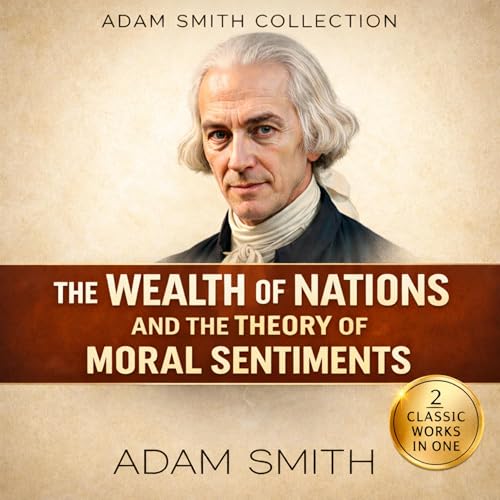
Adam Smith Collection
The Wealth of Nations and the Theory of Moral Sentiments
Failed to add items
Add to Cart failed.
Add to Wish List failed.
Remove from wishlist failed.
Adding to library failed
Follow podcast failed
Unfollow podcast failed
Get 30 days of Standard free

Adam Smith Collection
Buy for $30.21
-
Narrated by:
-
Roberto Scarlato
-
By:
-
Adam Smith
The foundations of capitalism, explained by the man who defined it.
This edition features a custom introduction offering clear biographical insight into Adam Smith’s life and the ideas that shaped the modern world.
The Wealth of Nations (1776), presented in its complete and unabridged form, lays the foundation for modern economic theory. Learn how self-interest, free markets, and the division of labor drive wealth and influence global systems.
The Theory of Moral Sentiments (1759) explores the psychology behind human behavior. Through the concept of “mutual sympathy of sentiments,” Smith reveals how empathy and morality shape the decisions we make.
Together, these works provide a complete framework for understanding both markets and human nature.
Spanning over 57 hours, this collection delivers two foundational works in one, offering exceptional depth and long-term value.
If you want to understand how money, markets, and human behavior truly work, this is where you start.
©2024 NextGen Publishing Studio LP (P)2024 NextGen Publishing Studio LPListeners also enjoyed...





People who viewed this also viewed...


Listener received this title free
A Perfect Rendering of this Seminal Work
Something went wrong. Please try again in a few minutes.
Listener received this title free
A must-listen for understanding modern economics
Something went wrong. Please try again in a few minutes.
Listener received this title free
Timeless wisdom of adam smith
Something went wrong. Please try again in a few minutes.
Listener received this title free
A Timeless Masterpiece of Economics and Morality
Something went wrong. Please try again in a few minutes.
Listener received this title free
A good overview of Adam Smith's work
Something went wrong. Please try again in a few minutes.