

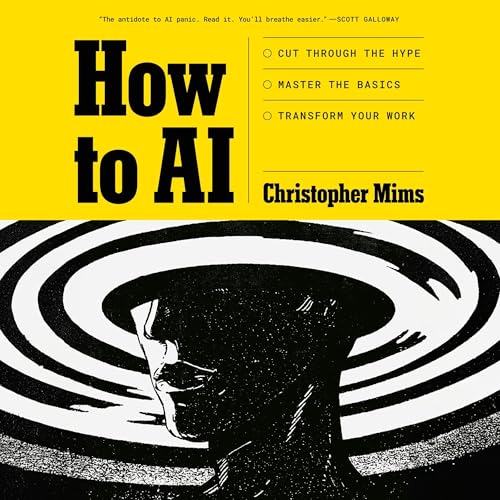
How to AI
Cut Through the Hype. Master the Basics. Transform Your Work.
No se pudo agregar al carrito
Solo puedes tener X títulos en el carrito para realizar el pago.
Add to Cart failed.
Por favor prueba de nuevo más tarde
Error al Agregar a Lista de Deseos.
Por favor prueba de nuevo más tarde
Error al eliminar de la lista de deseos.
Por favor prueba de nuevo más tarde
Error al añadir a tu biblioteca
Por favor intenta de nuevo
Error al seguir el podcast
Intenta nuevamente
Error al dejar de seguir el podcast
Intenta nuevamente
Obtén 30 días de Standard gratis
$8.99 al mes después de que termine la prueba. Cancela en cualquier momento

How to AI
Narrado por:
Christopher Mims
Compra ahora por $18.00
-
Narrado por:
-
Christopher Mims
-
De:
-
Christopher Mims
“The antidote to AI panic. Read it. You’ll breathe easier.”—Scott Galloway, NYU Stern School of Business professor and co-host of Pivot with Kara Swisher
“A clear, practical, and hype-free guide to the AI revolution that will resonate with anyone trying to figure out the how to make AI deliver real value.”—Ethan Mollick, Wharton professor and New York Times bestselling author of Co-Intelligence
AI is nothing to be afraid of. After all, AI is merely software. It’s great at some things and (at least right now) terrible at others. But for workers who take time to experiment with AI and develop expertise, AI will make them more productive and more creative, saving them time, giving them job security, and boosting their income.
In How to AI, Wall Street Journal columnist Christopher Mims introduces readers to people just like them who are at the forefront of using AI in the world of work. Imagine a freelance lawyer who suddenly has a whip-smart assistant to help her nail every deposition. Or a mom-and-pop contractor whose new software tool is automating construction bids that used to eat up hundreds of hours.
But even as half a billion people around the world have leapt at the chance to use ChatGPT and other tools, millions of us have stayed on the sidelines. Are you one of them? Maybe you feel you should be using AI tools, but you don’t know where to begin. Or maybe you love AI but find yourself struggling to get your co-workers or employees on board. In How to AI, Mims teaches readers twenty-four simple but eye-opening “laws” about AI and how we should approach it, including:
• AI is an assistant, not a replacement.
• AI isn’t creative, but it can help you be.
• Give AI your least favorites things to do.
• AI can’t create finished products, but it’s great at prototypes.
Animated by the wit and brilliant explanatory power that have earned Mims’s Wall Street Journal columns a devoted following, How to AI will prepare readers to become a part of the AI revolution—and, most important, arm them with the tools to make it work for them.
Los oyentes también disfrutaron:




adbl_web_anon_alc_button_suppression_c
Reseñas de la Crítica
“The antidote to AI panic. Read it. You’ll breathe easier.”—Scott Galloway, professor at NYU Stern School of Business and co-host with Kara Swisher of Pivot
“Finally, a new AI book that focuses on the key question so many people are facing: How
do I work with AI right now? Christopher Mims gives us a clear, practical, and hype-free guide. . . . How to AI is packed with so many good stories, tips, and explanations that anyone, novice or expert, is going to find insights that will change how they use (and think about) AI. Accessible, entertaining, and useful!”—Ethan Mollick, Wharton professor and New York Times bestselling author of Co-Intelligence
“Mims masterfully demystifies AI’s true potential, proving that the real revolution isn’t in replacing humans but in amplifying their capabilities—exactly the strategic insight every CEO needs right now.”—Aaron Levie, CEO of Box
“Engaging, practical, and grounded in real-world stories.”—Marc Benioff, chair and CEO of Salesforce
“Mims’s book is a rare find: an optimistic, realistic, and down-to-earth practical guide on how to use AI in daily life. Highly readable and immediately valuable.”—Melanie Mitchell, author of Artificial Intelligence: A Guide for Thinking Humans
“A clear and practical guide to making AI a true multiplier of human talent.”—Allan Thygesen, CEO of Docusign
“For anyone looking to be on the cutting edge of technology, from understanding AI to improving their lives with it, this book is a must-read.”—Kirkus Reviews
“Complex topics are presented with nuance and clarity, making the book accessible for a wide range of readers. Mims’ measured treatment of AI is a much-needed reality check in our era of AI alarmism. Highly recommended for business and technology collections.”—Booklist
“Finally, a new AI book that focuses on the key question so many people are facing: How
do I work with AI right now? Christopher Mims gives us a clear, practical, and hype-free guide. . . . How to AI is packed with so many good stories, tips, and explanations that anyone, novice or expert, is going to find insights that will change how they use (and think about) AI. Accessible, entertaining, and useful!”—Ethan Mollick, Wharton professor and New York Times bestselling author of Co-Intelligence
“Mims masterfully demystifies AI’s true potential, proving that the real revolution isn’t in replacing humans but in amplifying their capabilities—exactly the strategic insight every CEO needs right now.”—Aaron Levie, CEO of Box
“Engaging, practical, and grounded in real-world stories.”—Marc Benioff, chair and CEO of Salesforce
“Mims’s book is a rare find: an optimistic, realistic, and down-to-earth practical guide on how to use AI in daily life. Highly readable and immediately valuable.”—Melanie Mitchell, author of Artificial Intelligence: A Guide for Thinking Humans
“A clear and practical guide to making AI a true multiplier of human talent.”—Allan Thygesen, CEO of Docusign
“For anyone looking to be on the cutting edge of technology, from understanding AI to improving their lives with it, this book is a must-read.”—Kirkus Reviews
“Complex topics are presented with nuance and clarity, making the book accessible for a wide range of readers. Mims’ measured treatment of AI is a much-needed reality check in our era of AI alarmism. Highly recommended for business and technology collections.”—Booklist
Las personas que vieron esto también vieron:







Immediately deployed relevant information
Se ha producido un error. Vuelve a intentarlo dentro de unos minutos.
Mims is at his best when explaining broad concepts. He sketches the contours of modern AI with efficiency, offering snapshots of how companies are deploying these tools in real-world settings. But the book often lingers too long in places where a lighter touch would have sufficed. A case study on Clorox, for instance, is described in such detail that it begins to feel padded, as though a magazine article has been stretched to fill a book-length frame.
More striking is what the book leaves out. In a field defined by a handful of dominant players and bold personalities, Mims gives surprisingly little attention to Elon Musk and the constellation of companies and ideas surrounding him, including xAI, its chatbot Grok, and the ambitions behind the Optimus. He doesn’t even mention Tesla's Full Self-Driving (FSD), widely recognized as one of the most prominent, large-scale examples of Physical AI (or embodied AI) in operation today. Whatever one thinks of Musk, his ventures are central to current debates about AI’s direction, and their relative absence here creates a noticeable gap. To some extent, this omission may reflect the velocity of change in the field, but it also underscores a broader limitation: the book already feels dated, despite its recent publication.
As prose, How to AI is consistently lucid. Mims has a journalist’s instinct for clarity and pacing, and the book moves quickly. But the audiobook version introduces an unexpected drawback. His narration, marked by a rising cadence at the end of sentences, becomes distracting over time, drawing attention away from the material itself. Ironically, a synthetic voice, the very technology under discussion, might have delivered a smoother experience.
For readers seeking a clear, high-level introduction to how AI is being used today, How to AI has value. But those looking for a true “how-to” manual, or a deeper engagement with the most consequential players shaping the field, may come away feeling that the book gestures toward the future without quite helping them navigate it.
A Useful Survey That Stops Short of Teaching
Se ha producido un error. Vuelve a intentarlo dentro de unos minutos.
Pretty useful information?
Se ha producido un error. Vuelve a intentarlo dentro de unos minutos.
a very accurate guide on current A.I.
Se ha producido un error. Vuelve a intentarlo dentro de unos minutos.