

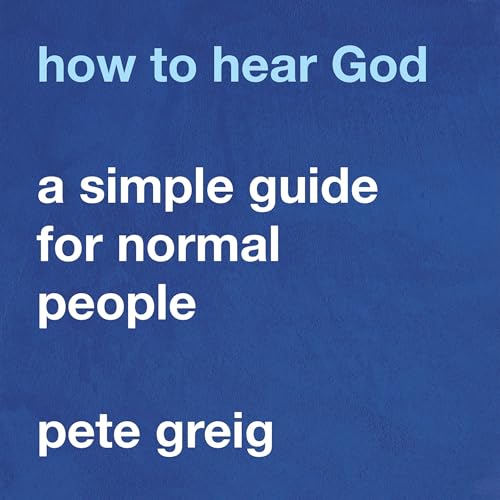
How to Hear God
A Simple Guide for Normal People
Failed to add items
Add to Cart failed.
Add to Wish List failed.
Remove from wishlist failed.
Adding to library failed
Follow podcast failed
Unfollow podcast failed
Audible Standard 30-day free trial

How to Hear God
Buy for $23.39
-
Narrated by:
-
Pete Greig
-
By:
-
Pete Greig
You were created to enjoy a real, conversational relationship with God.
The Bible says that hearing the voice of our Creator is both central and natural to our existence as humans.
- When life falls apart, we need God's comfort.
- In moments of cultural turmoil, we need his clarity.
- Facing difficult decisions, we need his guidance.
- Desiring a deeper faith, we need God to say something, anything, to turn the monologue we call prayer into a genuine conversation.
But how do we really hear God?
Nothing could possibly matter more than learning to discern his authentic voice, and yet few things in life are more susceptible to delusion, deception, and downright abuse.
Having addressed God's silence in God on Mute, and then How to Pray in his previous bestseller, Pete Greig is back to bring wisdom and guidance to one of the most pressing and perplexing aspects of universal Christian experience—How to Hear God.
Exploring the story of Christ's playful, poignant conversation on the road to Emmaus after his resurrection, Pete draws deeply from the insights of a wide range of Christian traditions; weaving together the evangelical emphasis on hearing God in the Bible, and the charismatic commitment to hearing God in the prophetic, with the contemplative understanding of God's "still, small voice" within.
"Pete transcends the Christian tribalism of our day… rooting us in something far more ancient, unchanging, timeless. What the early Christians called the Way. This ancient form of Christianity is the antidote to much of the modern church's pain. The cure for our ills." —John Mark Comer
Listeners also enjoyed...




People who viewed this also viewed...


I have previously read Greig’s How to Pray, also as a part of the Renovare Book Club. How to Hear God is very similar in feel. Greig is a good story teller. He writes short and straight forward chapters with reflection points, questions to think about, historical examples of people who have heard from God in the ways he is describing and biblical examples that ground his methodological examples.
As I said in my previous review of Greig’s book, I have a mixed view of the 24/7 movement. I think Greig is solid and I don’t have any concerns about him or his books. But I do have concerns with some of those who are a part of that movement in the US and some of the ways that the theology of the 24/7 movement can lead to a type of dominionism that becomes a problem. Greig actively opposes some of those misuses of his ideas and theology here, but willful misuse often is difficult to counter.
Part of what I appreciate about Greig’s method is that he knows there is going to be both, misunderstanding of God’s word to us, and that misuse of the claim to hear from God to control others. He really does actively work against that. So I don’t want to minimize that. But part of my take away here, is that we need health in many areas of life to use our gifts and skills well. A person who is not self reflective about the mixed motives that we have at all times, will not be able to discern well, what God is saying to them. A person who views God primarily as a tyrant waiting for you to mess up, will be unlikely to hear words of comfort or calls to rest. That basic thought goes in many directions, so as much as Greig is calling us to test what we think we hear from God, those who are unlikely to do the introspective work of discernment are quite likely to also misuse claims of hearing from God to abuse or control others. And correspondingly, those who are mature and discerning are going to be fairly likely to be responsible, so that as a short hand, the more controlling a person seems to be about hearing from God, the more likely they are to be immature or wrong.
At the same time, I think that Greig is right that hearing from God is like a muscle that needs to be exercised and used to develop. He has lots of short cut acronyms or mnemonic devices to help think about right use and evaluation of our hearing from God. I am not going to walk through all of them, but I do think he has thought about them well and is trying to raise appropriate red flags to wrong practices while rightly encouraging people to know that they are not going to get it perfectly right all the time. That permission to fail, but greater caution with God’s word for other people, I think rightly places the greater attention on internal rather than external words of God.
I also appreciate that while he doesn’t minimize God’s word through scripture, he doesn’t limit God’s word to only scripture as some streams of Christianity do. Greig is very ecumenical. I know people who have connections to his work and part of what encourages me is precisely that he is working ecumenically and not attempting to dominate others.
As I have said many times, I am in a long reading project about Discernment, and an essential part of discernment is hearing from God. I still think that the work of discernment needs to be rooted in character development and virtue, but it isn’t only that. To rightly discern, we need to develop our ability to hear from God through scripture, others people and various other methods. And this is a good book to work through various ways to hear from God in a readable, orthodox and practical ways.
God wants to talk to us.
Something went wrong. Please try again in a few minutes.
An Imperative Classic
Something went wrong. Please try again in a few minutes.
The overall simplicity of what he is teaching and how I can use it in my own daily walk.
Something went wrong. Please try again in a few minutes.
Biblical, personal, historical, practical
Something went wrong. Please try again in a few minutes.
One of my top favorite Christian reads
Something went wrong. Please try again in a few minutes.