In The Garden Podcast By Gordon Clinton Williams M.Ed. cover art

In The Garden

In The Garden

By: Gordon Clinton Williams M.Ed.
Listen for free

In The Garden is a daily journey through the Scriptures, an invitation to slow down, breathe deep, and walk with God in the garden of His Word.

Hosted by Gordon C. Williams, M.Ed. (usually called Clint), In The Garden blends biblical storytelling, poetic interpretation, ancient context, scientific curiosity, and Christ-centered teaching into a warm, reflective, and deeply accessible radio-style program. Each episode guides listeners through the Bible, from Genesis to Revelation, with the humility to honor both the literal and the literary beauty of the text.

Genesis, for example, is approached as many Christians across the centuries have read it: true, inspired, God-breathed Scripture, written in the rich language of Hebrew poetry and theology—not as a modern science textbook. Clint explores how creation’s “days” can be understood poetically, symbolically, and even scientifically, without dismissing the possibility of a literal seven-day creation. He invites listeners to consider how a timeless Creator, who stands outside of time, could shape a universe that feels ancient to us yet unfolds at His command.

Every episode follows a simple rhythm:

  • Listen to the story
  • Consider its original context
  • Explore its symbols and themes
  • Reflect on what it reveals about humanity
  • Look for how the story leads to Jesus

Throughout the journey, Clint draws from Hebrew word studies, the narrative structure of Scripture, historical and cultural background, and the words of Jesus Himself—always returning to the conviction that the whole Bible tells the One Story that leads to Christ.

Whether unpacking the symbolism of Adam and Eve, the spiritual psychology of Jacob and Esau, the rise of agriculture beneath the story of Cain and Abel, or the meaning of covenant in the life of Abraham, In The Garden offers thoughtful, accessible teaching for listeners from every background: lifelong Christians, curious seekers, new believers, recovering skeptics, and anyone longing to rediscover the beauty of Scripture.

In The Garden was born in West Texas and is broadcast locally on KCKM 1330 AM, where neighbors, families, truckers, farmers, teachers, and everyday people tune in weekly to hear the Word of God taught with tenderness, craftsmanship, and hope. The podcast version, released shortly after each broadcast, offers an extended edition for listeners who want to dig a little deeper.

Wherever you listen from, you are invited to step into the garden. Here, among the stories of Scripture, we learn how to cultivate the soil of the heart, plant seeds of wisdom, uproot the weeds that choke our joy, and walk with our Lord in the cool of the day.

This is In The Garden. Welcome. Your time here is holy ground.

Green Mission
Christianity Ministry & Evangelism Spirituality
Episodes
  • Exodus 15: From Singing to Grumbling
    Mar 22 2026

    They had just watched the Red Sea split and sang songs of victory. Three days later, the same people were grumbling in the wilderness.

    In Exodus 15 we see both the beauty of joyful worship and the fragility of human faith—and the unchanging faithfulness of God.

    After Israel’s miraculous deliverance from Egypt, Moses and the Israelites respond the only way a rescued people can: they sing. Exodus 15 records the first great song of redemption in the Bible. Moses leads the people in praising the Lord for defeating Pharaoh’s army and delivering them from slavery.

    “I will sing to the Lord, for He is highly exalted; He has thrown the horse and its rider into the sea.” (Exodus 15:1)

    Soon Miriam the prophetess joins in. With tambourine in hand, she leads the women in music and dancing as the whole community celebrates what God has done. Singing, music, and joyful movement become the natural expression of hearts that have witnessed the power of God.

    But the celebration does not last long.

    Only three days into their journey in the wilderness, the people cannot find drinkable water. When they finally reach water at Marah, it is bitter. The same voices that had just been singing now begin to complain.

    “The people grumbled to Moses, ‘What are we going to drink?’” (Exodus 15:24)

    Exodus 15 reveals how quickly human hearts can move from worship to worry, from praise to complaint. Yet the chapter also reveals the patience and mercy of God. Instead of abandoning His people, the Lord provides a solution. Through Moses, He turns the bitter water sweet and begins to teach Israel what it means to trust and obey Him.

    Here God reveals a powerful name: Yahweh Rapha — “The Lord who heals you.” The God who delivered Israel from Egypt is also the God who sustains and restores His people in the wilderness.

    The chapter closes with a beautiful picture of grace. After the bitterness of Marah, the people arrive at Elim—a place of abundance with twelve springs of water and seventy palm trees. Even though Israel’s faith was shallow, God’s faithfulness was not.

    Exodus 15 reminds us that while our faith may waver, the Lord continues to provide, guide, and heal. The same God who leads His people through the sea also leads them through the wilderness.

    If this episode encouraged you, share it with a friend, subscribe to the podcast, and continue reading through Scripture with us as we follow The One Story That Leads to Jesus.

    Scriptures Referenced:

    Exodus 15:1

    Exodus 15:20–21

    Exodus 15:24

    Exodus 15:26–27

    Show more Show less
    5 mins
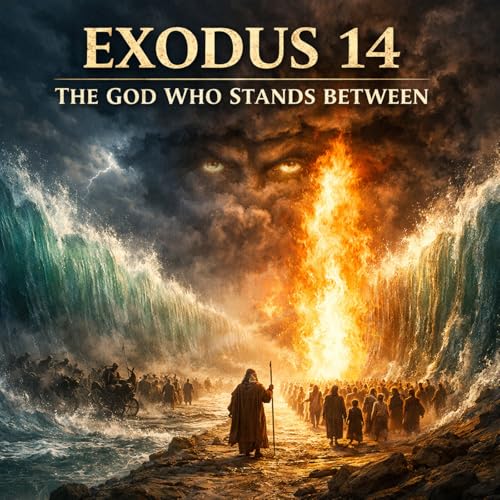
  • Exodus 14: The God Who Stands Between
    Mar 21 2026

    The sea split, the wind roared, and Israel walked through on dry ground—but the greatest revelation in Exodus 14 is not the miracle. It’s the God who stands between His people and their enemies.

    In this episode, we explore how the crossing of the Red Sea echoes the very first days of creation and reveals the Creator who still commands the wind, the waters, and the destiny of nations.

    Exodus 14 is one of the most dramatic moments in the Bible. Israel is trapped between Pharaoh’s army and the Red Sea with no visible escape. But the God who created the heavens and the earth is still present in His creation.

    Before the waters even divide, something extraordinary happens: the pillar of cloud and fire that had been leading Israel moves behind them. God places Himself between His people and the Egyptian army. The same presence that gives light to Israel brings darkness and confusion to Egypt. Salvation for one side, judgment for the other.

    Then the Lord sends a powerful east wind that blows through the night. The waters divide, dry land appears, and Israel walks through the sea. The language echoes Genesis itself—when the Spirit of God moved over the waters and the dry land first appeared. At the Red Sea, the Creator moves again. The wind blows, the waters separate, and a path opens where none existed.

    Scripture even tells us that the Lord looked out from the pillar of fire and cloud upon the Egyptian army. God is not distant in this moment—He is personally present, guiding, protecting, and judging. The same act that delivers Israel becomes the downfall of Pharaoh’s army.

    Exodus 14 reveals a powerful truth about God’s presence. The same God who saves also judges. The same pillar that lights the path for Israel blinds their enemies. It is like a scroll written on two sides—deliverance on one side and judgment on the other.

    When the waters close and the danger is gone, Israel finally sees what God has done.

    They see His power.

    They fear the Lord.

    And they believe.

    But this moment raises a deeper question that will shape the rest of the Bible.

    Will Israel trust God when the sea is no longer splitting?

    Because most of life is not lived in Red Sea moments. Most days are wilderness days—days when miracles are quieter and faith must rest on remembering what God has already done.

    The God who separated the waters at creation, the God who opened the sea for Israel, is still the One who stands between His people and destruction.

    If this episode encouraged you, share it with someone who needs a reminder that God still makes a way where none seems possible. And join us as we continue exploring the story of Scripture—one chapter at a time.

    Keywords: Exodus 14, Red Sea crossing, pillar of fire and cloud, biblical theology, creation echoes, God’s presence, faith in the wilderness, Old Testament study, Bible podcast.

    Scriptures referenced:

    Genesis 1:2–3

    Exodus 14:19–22

    Exodus 14:24

    Exodus 14:31

    Isaiah 60:1–2

    Ezekiel 2:10

    Show more Show less
    6 mins
  • Exodus 13: The Firstborn Belong to God
    Mar 20 2026

    A lamb dies so the firstborn can live. But what happens after the deliverance?

    In Exodus 13, God reveals that every rescued life now belongs to Him—and the story traces all the way back to Isaac and forward to Christ.

    After the night of Passover in the Book of Exodus, Israel begins its journey out of Egypt. But before they travel far, God stops them with an unexpected command: “Consecrate to me all the firstborn.” Every firstborn child and animal now belongs to the Lord because He spared Israel’s sons on the night when Egypt’s firstborn died.

    This moment reveals a central truth of redemption: the life that is saved now belongs to the Savior.

    In this episode of In the Garden, we explore the deeper meaning behind Exodus 13 and how the command about the firstborn connects to one of the earliest stories of substitution in Scripture. Centuries before the Exodus, Abraham climbed Mount Moriah with his beloved son Isaac. Isaac asked a haunting question: “Where is the lamb?” Abraham answered with faith: “God will provide the lamb.”

    At the last moment, a ram caught in a thicket took Isaac’s place.

    That same pattern appears again at Passover. Each household sacrificed a lamb, and the blood was spread on the doorposts with a branch of hyssop. The lamb died, and the firstborn lived.

    In Exodus 13, God establishes a memorial so this truth would never be forgotten. The Feast of Unleavened Bread and the consecration of the firstborn surround the story of Passover like a literary frame, reminding every generation that their deliverance came through substitution.

    But the story does not end in Egypt.

    During another Passover centuries later, Jesus Christ walked toward the cross carrying the wood of His sacrifice—just as Isaac once carried the wood up Mount Moriah. At the crucifixion, even the small detail of a hyssop branch appears again, echoing the Passover night when lamb’s blood marked the doors of Israel.

    What began with one son spared through a substitute in Genesis becomes the salvation of a nation in Exodus—and ultimately the redemption of the world through Christ.

    In this episode, we explore how Exodus 13 reveals the meaning of redemption, why God claims the firstborn, and how the story of Passover points both backward to Isaac and forward to the Lamb of God.

    If this episode deepens your understanding of Scripture, consider sharing it with a friend, subscribing to the podcast, and joining the conversation. Together we are discovering how the entire Bible tells one story that leads to Jesus.

    Scriptures referenced in this episode:

    Book of Exodus 12:13, 12:22, 13:2–16

    Book of Genesis 22:2–14

    Gospel of John 1:29, 19:29

    Show more Show less
    5 mins
No reviews yet