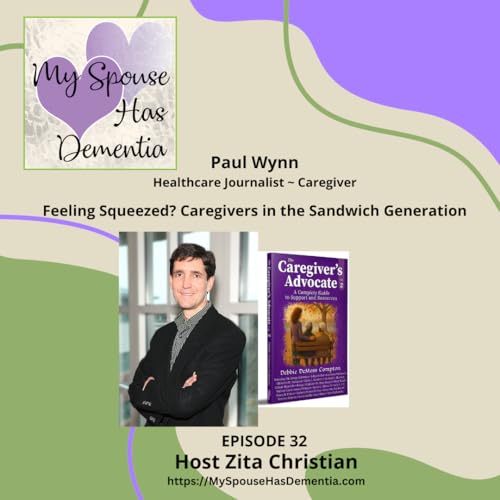
My Spouse Has Dementia Podcast By Zita Christian cover art

My Spouse Has Dementia

My Spouse Has Dementia

By: Zita Christian
Listen for free

A free, bi-weekly podcast that uses personal stories, occasional interviews, and simple rituals to support dementia caregiving spousesZita Christian 2024 Relationships Social Sciences
Episodes
  • Feeling Squeezed? Caring for a Parent with Dementia while Raising Your Young Family
    Jan 20 2026

    What's it like to be the caregiver for your parents while raising a young family of your own, and your wife is pregnant? Not easy!

    Healthcare journalist Paul Wynn writes about caregiving issues for more than 70 national publications. He also knows what it's like to be a caregiver, sandwiched between two generations.

    That personal story is the subject of "Surviving the Sandwich Generation Years: How to Balance Caring for Parents While Raising Kids", one of twenty-two stories in the award-winning anthology, The Caregiver's Advocate: A Complete Guide to Support and Resources, Vol 2, edited by Debbie DeMoss Compton.

    In the story, Paul describes life as a boy, watching his mother take care of his grandmother. He noticed his mother's patience and tenderness and how much his grandmother seemed to appreciate his mother's company. Those simple observations would serve him well as an adult.

    Here's an excerpt from Paul Wynn's story. It takes place over a ten-day period. At the time, Paul is married, the father of two young children. He and his wife live in New York. His father has died. His mother lives in Pennsylvania. She has dementia. So does his uncle. "...I rented a U-Haul truck and moved my uncle's personal belongings from his home to a Catholic-run assisted living facility where he moved into a studio apartment. The next weekend, Julia and I welcomed our third child."

    Every story in the anthology offers a helpful resource or caregiving tip. You can find the book on amazon.

    You can reach Paul Wynn at his website.

    Show more Show less
    43 mins
  • AI Resurrects Your Dead Loved One: A Miracle? Or Emotional Whiplash?
    Jan 10 2026

    Imagine you open your computer, strike a few keys, and there's your spouse…who died three years ago – like my husband did. You aren't looking at a photo. Or a video. No. This is more like Zoom or Facetime.

    The image you see looks, acts, and moves just like your spouse. Sounds like your spouse, too. You stare in disbelief as the image smiles and says, "Honey, I've missed you."

    What's your gut reaction? An AI miracle? Or emotional whiplash?

    This past August, I received an email from a man who described a new AI platform he had created. He described the platform's ability to gather photos and voice recordings of someone who died and blend them with memories shared by the deceased person's family.

    He wanted to demonstrate his AI tool here, on this podcast. In his own words, "I'd be happy to demonstrate this live on your podcast, or even help you reconnect with someone from your own circle…"

    So if I were to use his platform, I could strike a few keys on my computer and my husband would appear on the screen…as though he were alive. Understand me clearly: I love fairy tales but I don't live in one. The creator claims that what his platform can provide is comforting. I find it cruel.

    In an effort to see this issue from another angle, I sought the opinions of friends, family, members of my dementia support group, members of my bereavement group, and health professionals, including nurses and a grief therapist. My opinion has not changed.

    Show more Show less
    29 mins
  • The Child Inside the Caregiver: How Your Childhood Attachments Shape Your Caregiving
    Dec 25 2025

    Your loved one is diagnosed with dementia. While you focus on symptoms, tasks and decisions, a long-standing pattern from your childhood is being triggered. That pattern will shape your caregiving style.

    That childhood pattern is also being triggered in your loved one. Understanding the pattern can help you understand your loved one's behavior.

    Understanding can lead to compassion for your loved one and for yourself.

    From her book, Dementia, Caregiving & Personal History: How to Help, Cope, Connect, and Heal, author Tami Anastasia writes: "Our earliest relationships influence how we connect with others: our need for closeness, our ability to trust, and how we respond to life cirumstanes."

    In this first of several interviews, Tami talks about the bonds we formed with the people who cared for us when we were children and how those deep-rooted attachment styles influence our relationships as adults, especially in times of stress or crisis.

    She sheds light on these four attachment styles:

    • Secure Attachment: Living with Confidence
    • Anxious Attachment: Seeking Validation Through Caregiving
    • Avoidant Attachment: Struggling with Emotional Closeness
    • Disorganized Attachment: Being Caught Between Love and Fear

    Tami Anastasia holds a masters in counseling with more than 30 years of experience supporting family and professional caregivers. To learn more about Tami and her book, please go to her website

    Show more Show less
    47 mins
All stars
Most relevant
This podcast leaves me wanting to hear more. My husband also has Alzheimer’s. Listening to this journey resonates with me and comforts me. We’re not alone.

From the heart

Something went wrong. Please try again in a few minutes.