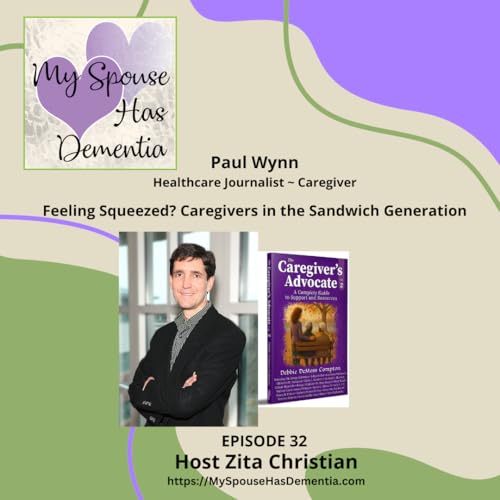
• Feeling Squeezed? Caring for a Parent with Dementia while Raising Your Young Family
    Jan 20 2026

    What's it like to be the caregiver for your parents while raising a young family of your own, and your wife is pregnant? Not easy!

    Healthcare journalist Paul Wynn writes about caregiving issues for more than 70 national publications. He also knows what it's like to be a caregiver, sandwiched between two generations.

    That personal story is the subject of "Surviving the Sandwich Generation Years: How to Balance Caring for Parents While Raising Kids", one of twenty-two stories in the award-winning anthology, The Caregiver's Advocate: A Complete Guide to Support and Resources, Vol 2, edited by Debbie DeMoss Compton.

    In the story, Paul describes life as a boy, watching his mother take care of his grandmother. He noticed his mother's patience and tenderness and how much his grandmother seemed to appreciate his mother's company. Those simple observations would serve him well as an adult.

    Here's an excerpt from Paul Wynn's story. It takes place over a ten-day period. At the time, Paul is married, the father of two young children. He and his wife live in New York. His father has died. His mother lives in Pennsylvania. She has dementia. So does his uncle. "...I rented a U-Haul truck and moved my uncle's personal belongings from his home to a Catholic-run assisted living facility where he moved into a studio apartment. The next weekend, Julia and I welcomed our third child."

    Every story in the anthology offers a helpful resource or caregiving tip. You can find the book on amazon.

    You can reach Paul Wynn at his website.

    Show more Show less
    43 mins
  • AI Resurrects Your Dead Loved One: A Miracle? Or Emotional Whiplash?
    Jan 10 2026

    Imagine you open your computer, strike a few keys, and there's your spouse…who died three years ago – like my husband did. You aren't looking at a photo. Or a video. No. This is more like Zoom or Facetime.

    The image you see looks, acts, and moves just like your spouse. Sounds like your spouse, too. You stare in disbelief as the image smiles and says, "Honey, I've missed you."

    What's your gut reaction? An AI miracle? Or emotional whiplash?

    This past August, I received an email from a man who described a new AI platform he had created. He described the platform's ability to gather photos and voice recordings of someone who died and blend them with memories shared by the deceased person's family.

    He wanted to demonstrate his AI tool here, on this podcast. In his own words, "I'd be happy to demonstrate this live on your podcast, or even help you reconnect with someone from your own circle…"

    So if I were to use his platform, I could strike a few keys on my computer and my husband would appear on the screen…as though he were alive. Understand me clearly: I love fairy tales but I don't live in one. The creator claims that what his platform can provide is comforting. I find it cruel.

    In an effort to see this issue from another angle, I sought the opinions of friends, family, members of my dementia support group, members of my bereavement group, and health professionals, including nurses and a grief therapist. My opinion has not changed.

    Show more Show less
    29 mins
  • The Child Inside the Caregiver: How Your Childhood Attachments Shape Your Caregiving
    Dec 25 2025

    Your loved one is diagnosed with dementia. While you focus on symptoms, tasks and decisions, a long-standing pattern from your childhood is being triggered. That pattern will shape your caregiving style.

    That childhood pattern is also being triggered in your loved one. Understanding the pattern can help you understand your loved one's behavior.

    Understanding can lead to compassion for your loved one and for yourself.

    From her book, Dementia, Caregiving & Personal History: How to Help, Cope, Connect, and Heal, author Tami Anastasia writes: "Our earliest relationships influence how we connect with others: our need for closeness, our ability to trust, and how we respond to life cirumstanes."

    In this first of several interviews, Tami talks about the bonds we formed with the people who cared for us when we were children and how those deep-rooted attachment styles influence our relationships as adults, especially in times of stress or crisis.

    She sheds light on these four attachment styles:

    • Secure Attachment: Living with Confidence
    • Anxious Attachment: Seeking Validation Through Caregiving
    • Avoidant Attachment: Struggling with Emotional Closeness
    • Disorganized Attachment: Being Caught Between Love and Fear

    Tami Anastasia holds a masters in counseling with more than 30 years of experience supporting family and professional caregivers. To learn more about Tami and her book, please go to her website

    Show more Show less
    47 mins
  • Love, Dementia, and Intimacy: How Alzheimer's Changes Marriage
    Jul 11 2025

    You will never regret being kind to your spouse.

    In a strong marriage, the sexual expression of love is the sinew that ties two hearts together and forms the kind of bond we depend on to get us through life's greatest challenges. As we age, the intensity of physical passion burns more ember than flame, but the bonds of love can be just as strong, even stronger, than ever.

    Alzheimer's forces a wedge in the relationship. Caregiver stress is more devastating than you imagined. Frustration and Anger barge into your home and wreak havoc in your daily world. Anticipatory grief destroys your dream of the future.

    Whether the dementia caregiving journey takes a few years or a decade or more, love doesn't fade from a strong marriage. The challenge is learning how to express that love in a new way.

    After marrying more than 150 couples, publishing 3 historical romance novels with Harper Collins, and being married for 41 years to a man I loved deeply, I've learned some things about weddings, romance, intimacy, and dementia. I share a few of those thoughts in this episode.

    Mentioned in the episode:

    John van Gurp's YouTube channel: John and Heather's Dementia Journey

    Be sure to listen to episode 28 about how using improv can help caregivers enter the world of their loved one. Let me know if you'd like to be part of an online improv class where all the participants are dementia family caregivers.

    I'm working a future episode about how it feels to have to care for a family member with dementia when you would never refer to that person as your "loved one." If that's you, please contact me. Email: zita@myspousehasdementia.com

    Show more Show less
    22 mins
  • Laugh, Breathe, Survive: Improv for Caregivers
    Jun 24 2025

    You know that caring for a loved one with Alzheimer's or other form of dementia can leave your mind confused, your body exhausted, and your spirit depressed. Yes, and what if I said there's something simple that might help you survive the caregiving journey? Yes, and what if I said this something is fun and free?

    I'm talking about improvisational theater, "improv" for short. Imagine a group of people on stage, making up a comedy skit as they go along. No experience required for what I'm suggesting in this episode.

    I've been talking with my nephew, Stephen Gillikin, co-founder of an improv group in Los Angeles and founder of a virtual improv class, about how improv techniques might help family dementia caregivers "enter the world" of their loved one.

    To read more about what I think could genuinely help family dementia caregivers, read the associate blog post on my main website, ZitaChristian.com

    Mentioned in this episode:

    Stephen Gillikin, Actor, Improv Teacher, my nephew

    International Women's Podcast Awards

    (Mentioned because out of almost 700 entries from 35 countries around the world, My Spouse Has Dementia was short-listed for the 2025 annual awards!)

    Episode 27, interview with Marty Schreiber, author of My Two Elaines

    In case you're wondering, I generated all of this content. Not AI.

    Show more Show less
    16 mins
  • My Two Elaines - A Governor's Dementia Caregiving Love Story
    May 10 2025

    "None of the books I read conveyed the ugly truth about caregiving: that it can destroy you – even kill you – if you go about it wrong."

    That's just a taste of the hard-hitting reality conveyed by author Martin (Marty) Schreiber in his memoir, "My Two Elaines." Elaine was Marty's highschool sweetheart and wife of 62 years when she died from Alzheimer's.

    As a former governor, Marty was prepared for the political responsibilities focused on leading the State of Wisconson. As a loving husband to a wife with Alzheimer's, he floundered.

    Marty talks bluntly about several aspects of caregiving:

    • the benefits of being told the truth of a diagnosis
    • the unique stress a husband faces when he is the caregiver
    • how asking for help can challenge a man's masculinity
    • how critical it is to enter your loved one's world when trying to communicate
    • the inevitable anger and frustration of trying to fix the unfixable
    • the danger of trying to cope with alcohol -- what Marty calls, "the caregiver's poison."
    • self-reflection, regrets, and the importance of sharing personal caregiving stories

    This is a love story. Sad. Strong. Encouraging.

    Martin Schreiber's website: My Two Elaines

    If you're caring for a spouse with dementia and are finding it hard to tell family and friends what you're going through, send them this link to Episode 23: The Caregiver You Love Needs Help

    Show more Show less
    28 mins
  • Care, Camera, Courage: One Husband's Dementia Story
    Apr 19 2025
    At part of their daughter's wedding ceremony, Heather was supposed to give their daughter a necklace that had once belonged to Heather's mother. Heather's husband, John, talks about what it was like when he and his daughter realized Heather had not brought the jewelry. "Our daughter actually took me aside before the ceremony and said, 'Dad, I've been wondering about something and I have to ask. Does mom just not care anymore or does she have dementia or something?'" In four short years, John Van Gurp watched his loving wife, Heather, fade from a beautiful, vibrant, creative, multi-tasker to a woman who can no longer dress herself, feed herself, or manage personal hygiene. Her decline has been fast. Like so many others in his position, John hoped his wife had been afflicted with something manageable. But after assorted labs and scans, the diagnosis was primary progressive aphasia, a form of dementia. For his own well being and to help other family dementia caregivers, John created a YouTube channel where he could post videos about the experience of caring for Heather. John came across episode 21 of this podcast where I shared a concept I call "anticipatory healing." He mentioned it on his blog. The internet brought us together and, in no short order, John agreed to be my guest on the podcast and talk about the journey he is taking with Heather, his wife of almost 40 years. John talks candidly about the challenges of managing what had always been Heather's tasks. "Suddenly I'm responsible for all the linens in the house, all the bedding and blankets and cloth stuff. I have no interest or, or knowledge or expertise in cloth stuff like curtains and pillows. Heather loved this stuff. She used to decorate with pillows and blankets. And I remember thinking once, Honey, you've left me. You've gone to live in your head and you didn't leave any instructions. ... I'm getting emotional here thinking about it, but you know, ... we didn't have a chance to talk about it. And you know, that's tough. That stuff is tough. The handover. Yeah, the handover is, is awfully hard." You can watch videos of John and Heather's caregiving journey on his YouTube channel. Just search for "John and Heather's Dementia Journey."
    Show more Show less
    1 hr and 5 mins
  • Visited Mom Today - An Interview with Author John D. Scully
    Feb 8 2025

    For 13 years, John Scully visited his mom in a nursing home. For the last 8 years of her life, she couldn't talk. So he had other conversations. And they became a book. It's called Visited Mom Today: Conversations Through the Lens of Alzheimer's and Dementia.

    Mentioned in the podcast:

    VisitedMomToday.com - The website of author John D. Scully

    Alz Authors, a podcast that interviews authors of dementia caregiving memoirs.

    Show more Show less
    30 mins