Read Me A Nightmare Podcast By Angelique Fawns cover art

Read Me A Nightmare

Read Me A Nightmare

By: Angelique Fawns
Listen for free

Season 2 of "Read Me A Nightmare" shifts its focus to conversations with writers, editors, and creators working in and around dark fiction — about craft, career, and the realities of making stories in the world.Visit www.fawns.ca to learn more. Please --if you enjoy the episode, leave a review!

angeliquemfawns.substack.comAngelique Fawns
Art Literary History & Criticism
Episodes
  • Growing an Indie Brand with David Hankins
    Mar 22 2026
    David Hankins and I have been writing short stories and learning the industry together for several years. He’s helped me when I’ve gotten stuck with my Writers of the Future entries. (like, why are they rejecting me?!) Authorial note— he took a story from rejected to Silver Honorable Mention.I’ve been watching him sell multiple short stories, run Kickstarters, and self-publish two fun novels with avid admiration.David has been an inspiration as I forge my own path through the many ways writers find success. He’s not afraid to try new things while always coming across as a professional.I interviewed him when he first won several years ago, and he read one of his shorts!This is his second time on the podcast, and feel free to check out his books and learn more about him, here: https://davidhankins.comAngelique: You seem to have a real method to your madness. When it comes to indie publishing, what have you found works?David: Really the way I tend to do things is I find the people who have done very well, and then I mimic what they do because clearly it worked for them. Then I see if I can do what they did in order to reach the next level. With publishing and writing books, I took a look at some of the big names who moved from traditional publishing over to primarily indie, like Dean Wesley Smith and Kevin J. Anderson. Dean gave us a class on the history of publishing, and it really came down to publishing changing dramatically about every fifty years. Right now we’re in the middle of one of those changes. Once he did that analysis, he moved straight over to what was new and where that was going, and I said, all right, I’m going to do the same thing.Angelique: I love that. So when you decided to publish Death and the Tax Man, why did Kickstarter make sense to you?David: Dean Wesley Smith has done a bunch of Kickstarters, and a bunch of others I had followed had done Kickstarters, and I was like, all right, I’m going to launch my first book with a Kickstarter, which was a smashing success. My profit was between thirty and fifty percent. That Kickstarter made about eight thousand dollars, so I made a profit of three to four. Which is great because that means I started in the green.Angelique: That’s amazing. And for anyone nervous about trying Kickstarter, what do you think the real risk is?David: The worst that happens is it doesn’t fund and you’re out nothing but time. But if you do the things that you have seen work, and you’ve observed other people, just mimic what they’ve done. Look at people who have run that kind of Kickstarter. For nonfiction especially, you’re trying to hook people in a different way than you would for a novel. It’s not the adventure, the mystery. It’s, here, learn how to do the thing.Angelique: What’s one of the biggest things you’ve learned so far from indie publishing your trilogy?David: I learned that there are lots of different audience pools out there. Kickstarter is its own pool of readers. The people who are supporting me on Kickstarter are not necessarily the people who are finding me on Amazon, because they do their book shopping on Kickstarter. There’s some crossover, but the growth that I had in Kickstarter did not translate over into Amazon reviews.Angelique: That’s so interesting. What did that teach you about reviews and momentum?David: One of the things that I was always hesitant on and didn’t really do was giving away copies to get reviews. A friend of mine is rapid releasing an urban fantasy series, and she’s doing ARC copies and giving away the free books. I was like, I just had people pay for it on Kickstarter. But it’s a totally different audience. They never would’ve found me on Kickstarter, and my Kickstarter people aren’t the ones who are going over there looking for ARC books to read and review.Angelique: So are you wide, or are you in KU?David: I’ve gone wide, and I’ve loved being wide. I can sell through my website, and I’ve actually sold more through my website and through direct sales, like me going to conventions and fairs and stuff like that. That’s where I made most of my money last year. If I were in KU, I couldn’t sell on my own website.Angelique: That direct sales piece is really interesting. What do you use to power that side of things?David: My sales engine is Square. They have a storefront, which is very basic. Here’s your book, book, book, price, click, buy. And that’s all I need. It integrates via links, so I have my book cover on my website and say, click here for my shop. I use Square because I started with them for in-person sales, because they’re very, very easy for in-person sales. I wanted something that integrated all the same stuff. I wouldn’t have to maintain two different tracking systems. If I sell out of a book in person, then it shows on my website as not available.Angelique: Since you’ve had success with in-person sales, what have you found makes the biggest ...
    Show more Show less
    35 mins
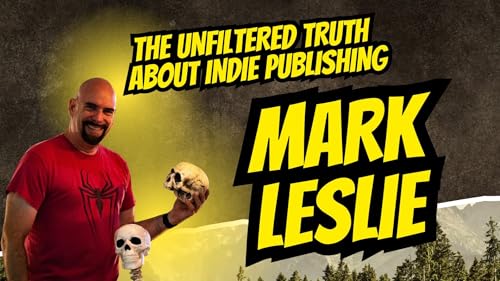
  • The Unfiltered Truth About Indie Publishing with Mark Leslie
    Mar 8 2026
    Mark is a writer, an editor, a professional speaker, and a book nerd with a passion for craft beer.He’s also an ambassador for the Canadian publishing industry and my mentor.Prefer video? Watch this interview on YOUTUBE. It’s worth your while… I include a clip where I failed to hit record on our 1st attempt at this interview. My expression and shock might be priceless. I met Mark Leslie several years ago when we took the same short story webinar. When he found out about my short story blog, he invited me onto his podcast.Here is my first chat ever with Mr. Leslie:Since then, we’ve become fast friends, and I bump into him all over the continent at writing conferences.All sorts of goodies in this podcast…You can learn more about Mark over at markleslie.caAngelique: You’ve said failure is just a data point and writers shouldn’t be afraid of it. What do you mean by that in publishing?Mark: I’ve been in this industry for a long time, and I’ve failed thousands of times. I’ve screwed up, done the wrong thing, and made mistakes constantly. But if it weren’t for those mistakes, I wouldn’t have learned. Sometimes, if something works accidentally, you think you knew what you were doing, and that can actually teach you the wrong lesson. Failure gives you information. It shows you what didn’t work, and that helps you adjust.Angelique: A lot of writers look for the magic formula. Is there one?Mark: No. There’s no magic bullet. There are good strategies, yes, but every single book is different, even for the same author. Every platform is different. Every reader is different. You can’t just copy what someone else did and expect the same result. You have to learn and adjust it according to what you’re writing, who you’re serving, and how you’re releasing it. A hundred authors can do all the so-called right things, and only a tiny percentage may still hit that perfect timing where everything aligns.Angelique: So writers shouldn’t just chase whatever seems to be working for everyone else?Mark: Exactly. Too many indie authors act like a bunch of ten-year-olds playing soccer, all chasing the ball around. They’re following the latest trend without thinking strategically. You have to think more like Wayne Gretzky, skating to where the puck is going to be. You have to figure out where your puck is, and your puck is going to be different from someone else’s. Most of the time it still won’t work, but every once in a while you’ll get a hit. That’s part of the game.Angelique: Is publishing really that unstable, even when something works?Mark: Absolutely. You can have a good year and still be broke the next year. There’s no guarantee in writing. You have to be able to pivot. I put out maybe three books a year on average, and they don’t all make money. Some books are successful, some do okay, and some are complete duds. So I’m playing the odds. I’m not waiting ten years and hoping one book becomes a blockbuster. I’m producing the books that are meaningful to me and releasing them with passion.Angelique: How important is talent compared to persistence?Mark: Talent matters, but it’s only one part of the equation. Persistence is huge. The writers who don’t quit are the ones who win. You’re going to get bad reviews, rejection, disappointing sales, and things that make you want to stop. But if you quit, that’s the end. You have to keep going.Angelique: How should writers handle negative reviews and readers who don’t connect with the work?Mark: You have to remember that not every reader is your reader. My mother never liked my writing because she was a romance reader and I didn’t write romance. That didn’t mean my books were bad. It just meant she wasn’t the ideal reader for me. The same is true with reviews. Some people are simply not the right audience. That’s okay. What matters is finding the people who do love what you write.Angelique: Why does having a body of work matter so much in publishing?Mark: Because one book rarely gives you enough leverage. When you spend money marketing one book, the math is tough. Maybe people click, maybe a few buy, but the return can be small. When you have more books, even if they’re not all in the same series, a reader who likes one can go looking for the others. That’s where the value of a backlist comes in. If someone discovers you and enjoys your writing, they may go buy more of your books. That’s one of the best reasons to keep building a body of work.Angelique: Does the backlist only matter if you write in series?Mark: Series make it easier, but no, it’s not only about series. If a reader connects with your voice or your storytelling, they may want more from you regardless. I’ve done that myself as a reader. I’ve read one book by an author and immediately gone out and bought everything else they wrote. That’s the power of a body of work.Angelique: For writers with anthologies or story collections, should ...
    Show more Show less
    32 mins
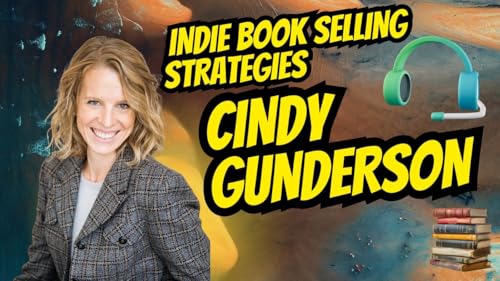
  • Indie Book Selling Strategies with Cindy Gunderson
    Mar 1 2026
    Okay, my fellow writers and readers,You are in for a treat. This remarkable woman is one of a kind. She’s authentic, friendly, and gave me so much actionable advice.And inspiration.And hope.Cindy has managed to create a thriving business without losing her sense of humor or fun. Her latest a-ah moment? She’s giving away her audiobooks for free on YouTube.FOR FREE. (Check it out)Though it’s completely counterintuitive, this is driving more sales for her. (Listen to learn more.) If you like YouTube, here is our interview in video form.And can you believe she initially grew her business to gangbuster numbers by using free social media marketing?Yup.I was lucky to meet Cindy at Superstars last year. (If you wonder about the benefits of cons, the connections and people you meet are worth every penny.)Here’s her official bio:Cindy Gunderson is a voice actress, content creator, and award-winning author. Since she has commitment issues, she writes sci-fi and fantasy, plus contemporary romance and women’s fiction under the pen name Cynthia Gunderson.After 25+ years of performing, voiceover and commercial work, instructing piano and vocal performance, and directing children’s theater, she turned to audiobook narration and production. She’s narrated, mastered, and produced over fifty-five audiobooks since 2020 in her home studio and has created a massive audio listener following/community on TikTok, YouTube, and other various audiobook platforms.Cindy’s first novel, Tier 1, was awarded First Place in Science Fiction at the 2021 CIPPA EVVY Awards, and her women’s fiction novel, Yes, And, was honored with the Indie Author Award’s first place prize for best adult novel in the state of Colorado, 2023.Let’s get real here. All we have to do is look at her titles and cover art to be drawn in.How clever is that title? You can listen to it here.Or this one:(Listen to it here)Okay, I could do this all day. So go ahead and click play on the podcast (link at top) or our YouTube interview. Here are some highlights below.If you want to learn more about Cindy,Her website is here: https://cindygundersonaudio.comMost of my content is free, but there is another tier for those who want to take their short story writing to the next level. AF: How many books did it take until you started to see some traction in your career?CG: It took me until I had 12 books out before I was making some money, and over 40 before I hit six figures. AF: Let’s talk about the day-to-day. Writing full-time is hard. What’s your routine—CG: I’m still figuring it out. Life variables change—kids’ schedules, my husband’s schedule—so what works one year doesn’t work the next. I’ve leaned into curiosity. My favorite phrase is, “I don’t have to do it forever.” I’ll try a routine, and if I hate it, I change it.AF: So what are your productivity goals?CG: What got me to six figures isn’t what will get me to the next level. I maxed out what I could do alone, so now I have two assistants, and we’re moving toward expanding the business. AF: What are they doing for you?CG: One is international—she helps with audio editing and content creation. The other does formatting, promo submissions, admin, Shopify tasks, and she’ll be helping more with book maintenance and my YouTube channel. Delegation is a whole skill set.AF: I heard you say it took five years to get to six figures—was that right?CG: Almost four years.AF: And is that gross or net?CG: Gross. Net depends on ad spend. The first year I hit six figures, I barely spent on ads because social media drove sales. That changed in the last 6–8 months—TikTok slowed down, platforms shifted—so I leaned harder into paid ads.AF: I love your social media posts where you pretend to be thinking like one of your main characters. Do those actually drive sales?CG: Yep. They used to drive more on TikTok than they do now, but they still work. My strategy shifted: social media used to be my sales strategy; now it’s connection, reader retention, superfans. Paid ads are more of a straight sales engine. And honestly, all the pieces work together—social, ads, Amazon, Meta, YouTube—you don’t always know which one “caused” the sale. Once I stopped trying to control it perfectly, it worked better.AF: When you say paid ads, what do you mean?CG: Mostly Facebook and Amazon right now. I also do promos by discounting—Chirp deals, Barnes & Noble promos. BookBub deals were okay for me, but expensive and stressful, so I don’t submit much anymore. Audio promos have been huge for me.AF: Where do most of your sales come from? Are you in KU?CG: I was wide for ebooks and doing Draft2Digital, but when social sales slowed, I talked to others and tried going back into KU. It was a huge boost. My audio is still wide, though. AF: Which audio platforms?CG: Audible, Chirp, Nook, Kobo, audiobooks.com—everywhere. And also free on YouTube.AF: Doesn’t free hurt paid?CG: Not in my ...
    Show more Show less
    31 mins
No reviews yet