• Good Strategy Helps People Make Tough Choices Under Uncertainty | Joel Grundy
    Mar 24 2026

    Strategy can feel like a choice between two bad options: a rigid annual plan that gets ignored by February, or constant agility that mistakes motion for direction. We sit down with Joel Grundy, Head of Strategy at Q5, to get back to what strategy is meant to do: help leaders make a small number of tough choices in an uncertain world, without pretending we can “bridle” the market into certainty.

    We dig into the lived reality of internal strategy work: building coalitions across investment, technology, people, and go-to-market teams, and staying close enough to leadership that strategy doesn’t become a factory of outputs. Along the way, we challenge the habits that flatten thinking, from purpose statements that drift away from what a business actually does, to pillars that become buckets for every initiative, to KPI lists that describe effects without naming the decisions that create them. Joel shares practical ways to improve strategic sensemaking, including war-gaming competitors and regulators, planning for shifting customer expectations, and keeping options open when you cannot know in advance what will work.

    Real-world examples bring it to life: AI as a “firework inside the business”; Netflix and Disney making identity-shaping bets on IP; Apple’s scale and the difficulty of placing meaningful bets; and what defence and rail teach us about why market forces cannot always be the guiding mind. We close with a grounded view of the strategist’s role: not telling people what to do, but giving decision-makers what they need, sometimes as an analyst and sometimes as a counsellor, always with humility.

    If you found this useful, subscribe, share it with a colleague who owns big decisions, and leave a review with the strategic question you’re wrestling with right now.


    Find Joel here: https://www.linkedin.com/in/joel-grundy-378b278/

    Send Mike a Message

    Enjoying the show?


    Subscribe and leave a review on your favourite platform — it helps more people find the podcast.

    🔗 Full episodes, show notes, and resources: https://www.lbiconsulting.com/strategymeetsreality-podcast

    📺 Watch on YouTube → https://www.youtube.com/@StrategyMeetsReality

    Connect with host Mike Jones → https://www.linkedin.com/in/mike-h-jones/

    Show more Show less
    55 mins
  • What If Everyone In Your Organisation Is Already Strategising? | Garin Rouch
    Mar 17 2026

    Strategy can look brilliant on paper and still fail the moment it meets the organisation that has to deliver it. We sit down with Gavin Rouch, an organisational development practitioner, to get honest about why that happens and what to do instead. We talk about organisations as interconnected systems in all their messy glory, where incentives, history, board pressure, and filtered information create strategic blind spots that senior leaders rarely see from the strategy room.

    We dig into what “good strategy execution” actually demands: participation that brings operational reality into the process, decision-making that generates real options, and the humility to speak in probabilities rather than perform certainty. Gavin shares why strategies often become propaganda, full of glittering generalities, why tough choices should provoke anxiety, and why the most valuable work is often the dialogue behind the tools. We also explore how emotion and sensemaking shape whether people invest in the direction, and why broadcasting strategy through comms alone leaves teams cold.

    From meeting waste and invisible knowledge work to HR and L&D translating strategy into capability building, we map practical ways to close the gap between intent and delivery. We finish with a clear message: strategy is not the exclusive domain of the senior leadership, and everyone has more agency than they think. If this sparked a few uncomfortable truths, subscribe for more, share the episode with a colleague, and leave a review with the biggest strategy gap you see right now.

    Send Mike a Message

    Enjoying the show?


    Subscribe and leave a review on your favourite platform — it helps more people find the podcast.

    🔗 Full episodes, show notes, and resources: https://www.lbiconsulting.com/strategymeetsreality-podcast

    📺 Watch on YouTube → https://www.youtube.com/@StrategyMeetsReality

    Connect with host Mike Jones → https://www.linkedin.com/in/mike-h-jones/

    Show more Show less
    53 mins
  • Leaders Don’t Own Plans; They Own Clarity | Jayson Coil
    Mar 10 2026

    Strategy only matters if it survives contact with reality. We sit down with operations chief Jayson Coil to unpack how intent, trust, and disciplined initiative turn a tidy plan into effective action when the stakes are high and time is short. From wildfire lines to boardrooms, we dig into what leaders can do today to bridge the gap between strategy and execution without slipping into control for control’s sake.

    Jayson shares frontline stories where readbacks, backbriefs, and honest After Action Reviews exposed interpretation gaps that would have sunk a plan. We talk through building contingencies that go beyond a single preferred course of action, running pre-mortems and red teams that actually change decisions, and the hard but vital habit of judging decision quality separately from outcomes. You will hear why punishing by outcome kills initiative and how to evaluate information sources, conduct bias checks, and make trade-offs instead.

    Mission command takes centre stage: not a slogan, but a system. We explore the concrete behaviours that build climate—leaders inviting critique, defining constraints and intent, and creating safe-to-fail simulations where everyone, including the boss, is accountable. We look at aligning policies, incentives, and discipline so they do not undermine empowerment, and why competence in standard practice is the passport to freedom to deviate when context demands it. Along the way, Jayson offers practical tests you can apply: if every deviation needs permission, you have not built mission command; if teams can act on intent and you will back sound judgment, you are getting close.

    If you want a clearer strategy, sharper execution, and a team that can adapt under pressure, this conversation delivers tools you can use: red teaming, readbacks, realistic training, and a relentless focus on “What is different today?” rather than “What’s the same.” Subscribe, share with a leader who needs it, and leave a short review with your biggest takeaway so we can keep raising the bar together.

    Connect with Jayson: https://www.linkedin.com/in/johnjaysoncoil/
    Jayson's Paper: https://drive.google.com/file/d/1WQ_pQL8_WGlIrAcxSpKOQqxhyLNVGKn3/view?usp=sharing

    Send Mike a Message

    Enjoying the show?


    Subscribe and leave a review on your favourite platform — it helps more people find the podcast.

    🔗 Full episodes, show notes, and resources: https://www.lbiconsulting.com/strategymeetsreality-podcast

    📺 Watch on YouTube → https://www.youtube.com/@StrategyMeetsReality

    Connect with host Mike Jones → https://www.linkedin.com/in/mike-h-jones/

    Show more Show less
    56 mins
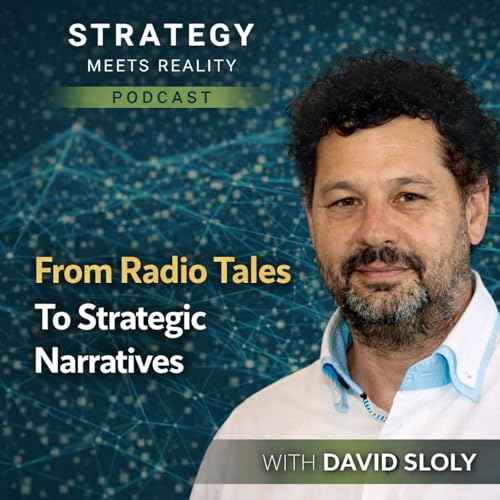
  • From Radio Tales To Strategic Narratives | David Sloly
    Mar 3 2026

    Strategy doesn’t fail in spreadsheets; it fails when people can’t see themselves inside it. We sit down with David Slowly—journalist turned radio producer turned B2B strategist—to unpack a practical, repeatable way to turn direction into action through narrative. David traces how radio taught him to spark imagination without visuals and how working with data-driven teams demanded proof that stories change minds. The result is a simple 5-4-3-2-1 toolkit leaders can use on Monday morning: five Ws for raw facts, four Ps (princes, purses, pets, places) to hook attention, three acts to structure challenge–struggle–resolve, two states to maintain emotional momentum, and one killer headline that sticks when the room closes the deck.

    We stress why most “strategies” read like to-do lists and how to shift from internal busyness to external effects. You’ll hear how to define the effect you want on your environment, then show what you will actually do to enable those effects to emerge. We build vision stories that make future states tangible without pretending certainty, and we argue for embracing ambiguity as a source of agency. People act when they feel trusted to fill intelligent gaps. That’s where identity matters: know what your organisation is today—capabilities, constraints, ethos—so you can choose the next credible moves and the options they unlock.

    Expect hands-on tactics you can apply now: one-message emails that reduce friction, headlines that are promise, intrigue, or news, and live read-backs to test whether a message landed. We show how to use real places and specifics to feel true to your culture, map likely struggles by function, and define a crisp resolve: when the smoke clears, what will be observably different out there. Tell the journey and cast your audience as the hero; they’ll start pre-solving as you speak. If people can’t picture it, they won’t do it—so give them a story that fits the work and earns belief.

    If this conversation helps you rethink how you communicate strategy, subscribe, share it with a leader who needs it, and leave a review with your one killer headline.

    Find David's work here: https://harveydavid.com/wp-content/uploads/2024/12/Why-You-Need-A-Business-Story-And-How-To-Create-It-1.pdf

    Send Mike a Message

    Enjoying the show?


    Subscribe and leave a review on your favourite platform — it helps more people find the podcast.

    🔗 Full episodes, show notes, and resources: https://www.lbiconsulting.com/strategymeetsreality-podcast

    📺 Watch on YouTube → https://www.youtube.com/@StrategyMeetsReality

    Connect with host Mike Jones → https://www.linkedin.com/in/mike-h-jones/

    Show more Show less
    1 hr and 2 mins
  • Building Futures Literacy For Smarter Strategy | Lasse Jonasson
    Feb 24 2026

    Strategy often treats the future like a straight road. We treat it like a landscape. With Lasse Jonasson, Chief Foresight Officer at the Copenhagen Institute for Futures Studies, we unpack how to swap predictions for preparedness and why language is the first tool of good strategy. When leaders share a vocabulary for assumptions, signals, and scenarios, conversations stop drifting and decisions start compounding.

    We dig into practical moves that any team can run this quarter. Start by stress testing your three-year plan against plausible ten-year futures: what must stay true for it to work, what signals would disprove it, and who owns the call to pivot. We show how to identify elements of your organisation that endure across scenarios and those that demand redesign. Rather than chase certainty, build optionality with explicit triggers, resource pathways, and decision rights. You’ll hear why “strategic ambiguity” is not vagueness but a guardrailed space where discovery and delivery both win.

    AI and geopolitics headline the change, but their real impact lies in how they reshape relationships, processes, and business models. Most leaders explore AI for efficiency; the advantage arrives when you reimagine work and value creation. We contrast the machine metaphor of management with the ecosystem metaphor, making the case for cultures that sense, adapt, and learn in public. We also challenge tidy hero stories and winner’s myths, highlighting how documenting assumptions and debates—now easier with AI—helps teams separate preparation from luck and improve cycle after cycle.

    If you’re ready to make strategy a living practice—futures literacy, scenario thinking, and identity-aware choices—this conversation will give you the prompts and patterns to begin. Subscribe, share with a colleague who owns a roadmap, and leave a review with the one assumption you plan to test next.

    Send Mike a Message

    Enjoying the show?


    Subscribe and leave a review on your favourite platform — it helps more people find the podcast.

    🔗 Full episodes, show notes, and resources: https://www.lbiconsulting.com/strategymeetsreality-podcast

    📺 Watch on YouTube → https://www.youtube.com/@StrategyMeetsReality

    Connect with host Mike Jones → https://www.linkedin.com/in/mike-h-jones/

    Show more Show less
    47 mins
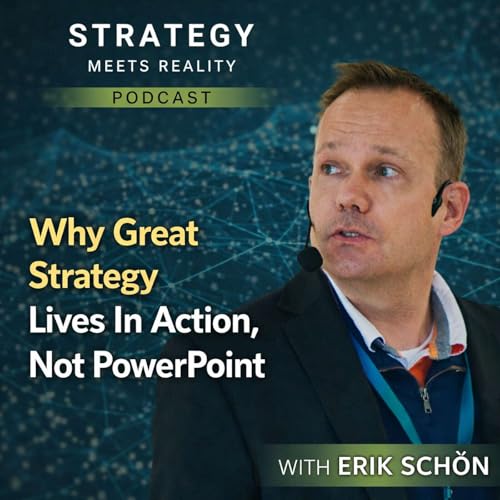
  • Why Great Strategy Lives In Action, Not PowerPoint | Erik Schön
    Feb 17 2026

    Strategy doesn’t live in a binder; it lives in motion. We sit down with practitioner-author Erik Schön to reconnect strategy with doing, drawing on Sun Tzu’s correlative pairs, Boyd’s OODA orientation, and Wardley Maps to turn abstract plans into concrete manoeuvres. From the first minutes, we challenge the ritual of annual decks and fixed KPIs, arguing for shorter strategy loops that privilege learning, outcomes, and a clear line of sight to the customer.

    Erik unpacks the engine behind durable advantage: the dance of expected and surprise. Customers must get the table stakes they anticipate, but loyalty and growth emerge when you add a well-timed, positive surprise. Think iPhone’s shock, or Ericsson’s practice of shipping at least one “desire to use” feature per release. We translate this into practical moves: mapping capabilities, exposing gaps, and deciding when to build, buy, or outsource. Wardley Maps become the team’s shared terrain, shifting debates from personalities to dependencies and evolution—from novel to commodity.

    We also tackle culture and cadence. Quarterly retrospectives and prospectives beat annual ceremonies because they compress feedback, curb KPI tunnel vision, and empower small experiments with fast ROI. Drawing on mission command, we favour firm intent with flexible plans: leaders set outcomes, teams design manoeuvres. Along the way, we explore why some firms stall on “expected, expected, expected,” how to avoid self-induced ambiguity, and what Eastern comfort with change can teach Western efficiency cultures. Real-world examples—from Netflix’s global-local bet to Nvidia’s pivot from gaming to AI—show how capability compounding and orientation shifts tilt markets.

    The close is a call to shape the conditions before you need a burning platform. Make the terrain visible, invest time in improvement work, and reward independent thinking within shared intent. If this conversation helps you see strategy as a daily practice—mapping, choosing, experimenting—tap follow, share with a colleague who loves real strategy, and leave a review with your biggest takeaway.


    Find Erik's work here:
    blog post: https://medium.com/an-idea/the-art-of-strategy-ac4165c0c085
    Book site: https://yokosopress.jimdofree.com/#ArtOfStrategy

    Send Mike a Message

    Enjoying the show?


    Subscribe and leave a review on your favourite platform — it helps more people find the podcast.

    🔗 Full episodes, show notes, and resources: https://www.lbiconsulting.com/strategymeetsreality-podcast

    📺 Watch on YouTube → https://www.youtube.com/@StrategyMeetsReality

    Connect with host Mike Jones → https://www.linkedin.com/in/mike-h-jones/

    Show more Show less
    49 mins
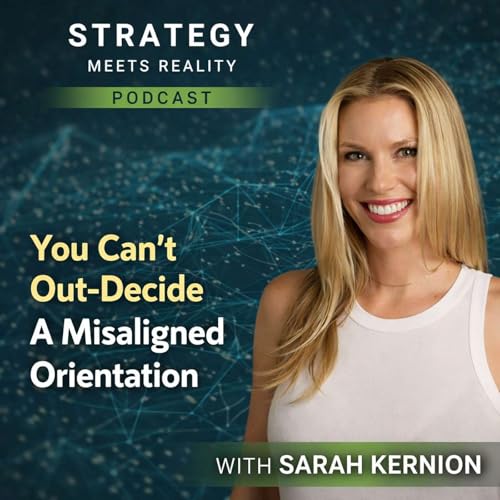
  • You Can’t Out-Decide A Misaligned Orientation | Sarah Kernion
    Feb 10 2026

    What if the most powerful strategy lessons aren’t found in boardrooms but in everyday life at the edge of uncertainty? We sit down with Sarah Kernion, founder of Inch Stones and mother of two non-speaking autistic children, to explore how frontline parenting becomes a masterclass in orientation, sense making, and adaptive leadership. The conversation is candid, challenging, and grounded: you can’t outdecide a misaligned orientation, and quick decisions that endure are the by-product of clarity, not adrenaline.

    We dig into why “inch stones” beat grand milestones when growth isn’t linear and why accommodations, far from signalling weakness, often expose the exact places a system can get stronger. Sarah shares practical examples, like visual scheduling that helped her children and unexpectedly improved routine for a neurotypical sibling—proof that inclusive design scales value. Together we dissect John Boyd’s OODA, clearing up the myth that it’s about speed. Orientation is not what you see; it’s how you make sense of what you see. Leaders who build cultures of sense making ask better questions, retire dead KPIs, and trade control for clarity—because comfort is optional, but learning is non-negotiable.

    There’s also a provocative look at neurodiversity as an operational edge. Different brains notice different signals, and in dynamic environments that diversity of noticing can become decisive advantage. We talk echo chambers, identity, and how tactical humility keeps orientation tethered to reality. Expect crisp takeaways: replace fear with strategy, define outcomes before metrics, and anchor decisions in environment, intent, and constraints. When you do, speed emerges naturally, teams act with confidence, and progress compounds—one inch stone at a time.

    If this resonated, follow the show, share it with a colleague who protects green dashboards, and leave a review with the one assumption you’ll destroy and replace next.

    Send Mike a Message

    Enjoying the show?


    Subscribe and leave a review on your favourite platform — it helps more people find the podcast.

    🔗 Full episodes, show notes, and resources: https://www.lbiconsulting.com/strategymeetsreality-podcast

    📺 Watch on YouTube → https://www.youtube.com/@StrategyMeetsReality

    Connect with host Mike Jones → https://www.linkedin.com/in/mike-h-jones/

    Show more Show less
    53 mins
  • How Mission Command Solves The Strategy–Execution Gap | Stephen Bungay
    Feb 3 2026

    Strategy only matters if it changes what people do tomorrow. We bring Stephen Bungay, author of The Art of Action, to unpack how mission command turns intent into execution without drowning teams in detail. Instead of orders that prescribe how to act, directives clarify what to achieve and why it matters—freeing people to adapt their methods as conditions shift.

    We trace the roots from Prussian Auftragstaktik to modern NATO doctrine, then translate the core ideas into the boardroom. Stephen lays out a practical framework: share the real context, state higher intent and your own intent, surface implied tasks, and set clear boundaries. The heartbeat is the backbrief: teams explain how they’ll deliver the outcome, leaders confirm alignment, and everyone moves faster with fewer escalations. Along the way, we tackle the persistence of Taylorism, why lists and slide decks masquerade as strategy, and how over‑control smothers initiative while under‑guidance invites chaos.

    If you lead teams in uncertain markets, this conversation gives you tools to create high alignment and high autonomy at the same time. You’ll hear battle‑tested examples, from SOPs that help without handcuffing, to writing intent that drives real trade‑offs, to building situational awareness so people can decide well under pressure. Start small: give problems, not solutions; ask for a backbrief; reward judgement over compliance. Subscribe for more conversations on strategy that survives contact with reality, and leave a review to share where you’ll test mission command first.

    Send Mike a Message

    Enjoying the show?


    Subscribe and leave a review on your favourite platform — it helps more people find the podcast.

    🔗 Full episodes, show notes, and resources: https://www.lbiconsulting.com/strategymeetsreality-podcast

    📺 Watch on YouTube → https://www.youtube.com/@StrategyMeetsReality

    Connect with host Mike Jones → https://www.linkedin.com/in/mike-h-jones/

    Show more Show less
    49 mins