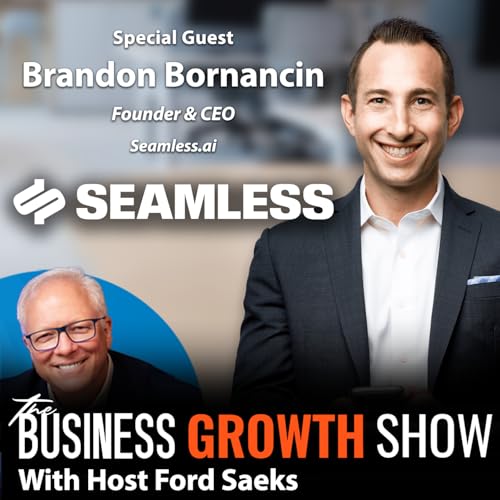
• S1Ep272 Sales Systems and Smarter Selling with Brandon Bornancin
    Mar 26 2026
    Sales systems are what separate unpredictable effort from repeatable results. In today's market, where buyers move faster, competition is louder, and attention is harder to earn, strong sales performance depends less on individual instinct and more on systems that create consistency. That is why Brandon Bornancin has built his career around helping professionals sell smarter. As Founder and CEO of Seamless, Brandon has focused on one challenge that nearly every growth-minded business faces: how to identify the right prospects, reach them efficiently, and move conversations forward without wasting time. His work has helped more than one million professionals improve how they approach pipeline development, lead generation, and revenue execution. Before building Seamless, Brandon's own entrepreneurial path included both rapid wins and hard setbacks. Early success taught him how quickly opportunity can scale, while later failures forced him to understand the discipline required to create sustainable systems. That combination shaped the philosophy he now brings to sales leadership: systems matter because they reduce guesswork and make performance repeatable. Sales systems are not just about automation. They are about creating clear frameworks that help people focus on what actually drives outcomes. In many organizations, sales teams spend too much time searching for information, chasing incomplete data, or reacting without structure. Brandon's approach addresses that by putting systems around prospecting, outreach, follow-up, and accountability. That philosophy aligns closely with what many business leaders are facing today. Buyers are more informed, sales cycles are more complex, and the pressure to create predictable revenue has never been higher. Sales systems provide a way to navigate that complexity by turning scattered effort into a process that can be measured, improved, and scaled. Brandon's work also reflects a broader shift happening across industries: technology is becoming most valuable when it removes friction rather than adding more noise. Sales professionals no longer need more disconnected tools. They need systems that help them act faster and think more clearly. That is where structured selling becomes a competitive advantage. Ford Saeks has long emphasized the same principle across business growth: strategy must lead execution. Without a clear process, even talented teams lose momentum. Sales systems create the structure that allows performance to compound. When people know what to do, when to do it, and how to improve it, confidence increases and results follow. One of the reasons Brandon's message resonates with founders, executives, and sales leaders is because it goes beyond theory. His perspective comes from building, testing, failing, refining, and scaling in real time. That experience gives weight to the idea that strong systems do not limit performance. They unlock it. Sales systems also strengthen leadership because they create clarity across teams. Instead of relying on individual style alone, organizations can define expectations, improve coaching, and identify where performance is breaking down. This becomes especially important as companies grow and need consistency across multiple people or departments. Another advantage of strong sales systems is that they make technology more useful. AI, automation, and sales intelligence only create value when they support a process that already makes sense. Without structure, tools simply accelerate confusion. Brandon's work consistently reinforces that technology should serve the system, not replace it. For business owners, the lesson is straightforward: better sales outcomes rarely come from doing more at random. They come from doing the right things repeatedly, with discipline and clarity. Sales systems make that possible by reducing wasted effort and increasing meaningful activity. As markets continue to shift, businesses that invest in smarter selling will have an advantage over those still relying on inconsistent effort. Sales systems provide a foundation that helps teams adapt, improve, and stay focused on outcomes that matter. Brandon Bornancin's work continues to highlight an important truth for modern organizations: the future of selling belongs to leaders who build repeatable systems, empower people to use them well, and stay committed to continuous improvement. Watch the full episode on YouTube. Join Fordify LIVE every Wednesday at 11 a.m. Central on your favorite social platforms and catch The Business Growth Show Podcast every Thursday for a weekly dose of business growth wisdom. About Brandon Bornancin Brandon Bornancin is the Founder and CEO of Seamless, a sales intelligence platform used by more than one million professionals worldwide. A bestselling author and entrepreneur, Brandon has dedicated his career to helping sales teams and business leaders improve prospecting, accelerate pipeline, and build systems that support...
    Show more Show less
    33 mins
  • S1Ep271 Luxury Branding Strategy and Premium Positioning with Kathryn Porritt
    Mar 19 2026
    Luxury branding strategy for premium positioning is not about surface-level aesthetics. It is about authority, perception, and strategic dominance within a clearly defined niche. For Kathryn Porritt, Founder and CEO of Iconic Empire, luxury branding strategy represents a decisive move away from commoditization and toward category leadership. Many businesses unintentionally anchor themselves in the middle of the market. They compete on incremental value, attempt to appeal to broad audiences, and rely on volume to sustain margins. Over time, this approach compresses pricing power and weakens differentiation. The brand becomes one of many options rather than the only logical choice. Luxury branding strategy challenges that model entirely. After building and selling her own multi-million-dollar company, Kathryn Porritt made a deliberate pivot. Instead of recreating a high-volume enterprise, she chose to work exclusively with accomplished experts and founders ready to reposition at the top of their markets. Her focus became helping extraordinary individuals claim iconic status by refining how they are perceived, priced, and positioned. Ford Saeks has long emphasized that positioning drives profitability. Growth without authority is fragile. When companies focus solely on marketing tactics without clarifying their premium positioning, they remain vulnerable to competition based on price. Luxury branding strategy addresses this vulnerability by elevating perception before pursuing scale. A core principle Kathryn applies is hyper-niching. While conventional wisdom encourages businesses to widen their audience, luxury branding strategy narrows it. The goal is to identify the deepest, most defensible niche where the brand can confidently claim leadership. When that clarity is established, the conversation shifts. Prospects no longer compare features. They evaluate authority. Authority transforms pricing dynamics. Premium positioning allows a business to move from justification to invitation. Rather than explaining why fees are higher, the brand communicates why it is the standard. Another defining characteristic of luxury branding strategy is the concept of descending scale. Traditional models often begin broad and attempt to climb upward into premium offerings. Kathryn advocates the opposite. Establish dominance at the highest tier first. Build brand equity through selective, high-value engagements. Once the brand is firmly anchored at the top, expansion becomes a strategic choice rather than a necessity. This approach mirrors the structure of global luxury houses that begin with exclusive offerings before extending into broader product lines. Prestige precedes scale. Luxury branding strategy also requires commercial clarity. Many experts possess deep mastery but struggle to translate that expertise into premium positioning. They undervalue their own authority because their messaging is diluted by mainstream marketing language. Kathryn's work centers on aligning how the brand communicates with the true level of capability it delivers. Ford Saeks often speaks about perception gaps. A business may generate exceptional outcomes, yet if the market perceives it as average, growth stalls. Luxury branding strategy closes that gap by ensuring that authority is visible, specific, and unmistakable. The economic environment further reinforces the importance of premium positioning. When markets tighten, companies in the middle feel the pressure first. Discounting becomes tempting. However, lowering price rarely strengthens brand equity. Instead, it signals vulnerability. Luxury branding strategy offers an alternative path. Rather than competing lower, compete higher. Premium positioning attracts a different caliber of client. Decision-making becomes more strategic. Engagements are deeper. Margins improve. Alignment increases. The experience shifts from transactional to transformational. Technology, including AI, supports execution but does not replace strategy. Automation can accelerate research, communication, and delivery. However, positioning requires discernment and vision. Tools assist. Leadership defines direction. Luxury branding strategy ultimately demands courage. It requires rejecting the comfort of broad appeal. It requires narrowing focus and standing firmly in a clearly articulated niche. It requires confidence in mastery. For leaders willing to move from commoditized to category leader, luxury branding strategy provides a disciplined framework. It is not about exclusivity for appearance. It is about clarity, authority, and sustainable premium positioning. Fordify LIVE streams every Wednesday at 11:00 a.m. Central across all social media platforms, featuring real-time conversations with business leaders and growth-minded experts. New episodes of The Business Growth Show podcast drop every Thursday. Watch the full episode on YouTube. About Kathryn Porritt Kathryn Porritt is the Founder and CEO of Iconic Empire,...
    Show more Show less
    39 mins
  • S1Ep270 Building an Accountability Culture with Sam Silverstein
    Mar 12 2026
    Accountability culture is not about rules, consequences, or compliance. It is about ownership. It is about people choosing to keep their commitments because they believe in what they are part of. For Sam Silverstein, accountability culture is the defining factor that separates average organizations from extraordinary ones. Many companies talk about accountability. Few actually build it into the fabric of how they operate. Silverstein has spent decades challenging leaders to rethink what accountability really means. Too often, it is treated as something imposed from the top down. A missed deadline results in blame. A mistake results in discipline. A performance issue results in pressure. But that approach does not create accountability culture. It creates compliance culture. The difference matters. In a compliance culture, employees do just enough to avoid consequences. In an accountability culture, people take ownership because they are committed to the outcome. They understand the expectations. They believe in the mission. They know their role matters. That shift from compliance to commitment is where performance transforms. Ford Saeks often emphasizes that sustainable business growth requires clarity. Clarity of vision. Clarity of expectations. Clarity of communication. Without clarity, teams default to assumptions. Assumptions lead to inconsistency. Inconsistency erodes trust. And without trust, accountability culture cannot exist. Silverstein's perspective reframes accountability as a promise, not a threat. When someone makes a commitment, they are giving their word. In strong cultures, a person's word carries weight. Leaders model this first. They do what they say they will do. They show up prepared. They follow through. They admit mistakes. That modeling creates permission for others to do the same. Accountability culture also requires alignment. It is not enough to post core values on a wall. Leaders must connect daily behaviors to those values. If integrity is a value, how does it show up in meetings? If service is a value, how is it demonstrated with customers? When values become behavioral standards rather than marketing language, accountability becomes measurable. Another key principle is ownership without excuses. In many organizations, people are quick to explain why something did not happen. The market shifted. The vendor failed. The deadline was unrealistic. While context matters, accountability culture asks a different question. What could we have done differently? That question shifts the focus from blame to responsibility. Silverstein often reminds leaders that accountability is not about punishment. It is about support. If someone misses a commitment, the conversation is not about shame. It is about understanding. What got in the way? What resources were missing? What needs to change moving forward? This approach strengthens relationships instead of weakening them. For growing companies, accountability culture becomes even more critical. As teams expand, complexity increases. Communication lines multiply. Without clear accountability, tasks fall through the cracks. Projects stall. Frustration builds. Leaders feel the weight of carrying too much themselves. When accountability is distributed throughout the organization, leadership capacity multiplies. Saeks frequently speaks about systems driving scalability. Systems create consistency. But systems only work when people are committed to executing them. Accountability culture ensures that systems are respected, refined, and followed. It bridges the gap between strategy and execution. There is also a financial impact. Organizations with strong accountability cultures tend to have higher employee engagement, lower turnover, and stronger customer loyalty. When employees feel ownership, they invest discretionary effort. They go beyond minimum standards. Customers feel the difference. Building accountability culture requires intentional action. Leaders must define clear expectations. They must create safe environments for honest conversations. They must hold themselves to the same standards they expect from others. Most importantly, they must reinforce accountability consistently, not only when something goes wrong. The shift does not happen overnight. Culture is built through repeated behavior. Each kept promise strengthens it. Each honest conversation reinforces it. Each aligned decision deepens it. Accountability culture is ultimately about respect. Respect for the mission. Respect for the team. Respect for the commitments made. When accountability becomes part of the identity of an organization, performance improves naturally. Not because people are forced to perform, but because they choose to. For leaders seeking sustainable growth, accountability culture is not optional. It is foundational. When ownership replaces excuses and commitment replaces compliance, organizations unlock a level of performance that no policy manual can enforce...
    Show more Show less
    22 mins
  • S1Ep269 AI for Restaurants and the Future of Restaurant Operations with Alex Hult
    Mar 5 2026
    AI for restaurants is no longer a futuristic concept reserved for large chains or experimental kitchens. It has become a necessary response to an industry weighed down by complexity, disconnected systems, and operational blind spots. Few people understand that reality better than Alex Hult, a founder whose path into restaurant technology was shaped not by theory, but by lived experience. Alex's journey into AI for restaurants began far from Silicon Valley. After a professional hockey career that took him around the world, he shifted into restaurant ownership, opening and operating multiple bars, nightclubs, and restaurant concepts across two states. That transition exposed him to the day-to-day realities of running hospitality businesses, from staffing and inventory to customer experience and profitability. It also revealed a fundamental problem: restaurant technology was fragmented, complicated, and often worked against operators rather than for them. As Alex scaled his restaurant group, he encountered a growing stack of tools that failed to communicate with one another. Point-of-sale systems, inventory platforms, labor tools, and reporting dashboards created more noise than clarity. Instead of empowering operators, technology added friction. That frustration became the catalyst for his next chapter and the foundation for AIO. AI for restaurants, as Alex envisions it, is not about replacing people or automating hospitality out of existence. It is about simplifying operations so leaders can make better decisions faster. AIO was built as an AI-first platform designed to unify restaurant data, eliminate silos, and give operators a single source of truth across their business. The goal is not complexity masked by intelligence, but clarity powered by it. This perspective resonates deeply within an industry that has been forced to adapt rapidly over the last several years. Rising labor costs, supply chain volatility, and shifting consumer expectations have made operational efficiency more critical than ever. AI for restaurants offers a way forward, but only if it is designed with operators in mind. Alex's background as a restaurant owner gives him credibility in a space crowded with tools built without firsthand understanding of hospitality. Rather than layering AI on top of broken systems, AIO was created to rethink how restaurant technology should function at its core. By consolidating data and surfacing insights that matter, the platform helps leaders focus on outcomes instead of dashboards. This approach reframes AI for restaurants as a practical business tool rather than a buzzword. Ford Saeks brings a complementary lens shaped by decades of helping organizations grow through alignment and execution. From his experience, technology only creates value when it simplifies decision-making and supports strategy. Businesses struggle when tools multiply faster than clarity. AI for restaurants becomes powerful when it reduces complexity, strengthens accountability, and supports leadership at every level. The restaurant industry is uniquely human. Success depends on people, process, and experience coming together seamlessly. Technology that disrupts that balance can do more harm than good. Alex's work emphasizes that AI should enhance hospitality, not interfere with it. By creating systems that serve operators, teams can spend less time managing tools and more time delivering great experiences. AI for restaurants also represents a shift in how founders and operators think about growth. Instead of adding layers of management or reactive reporting, intelligent systems provide foresight. That foresight allows leaders to address issues before they escalate, allocate resources more effectively, and maintain consistency across locations. In an industry defined by thin margins, those advantages compound quickly. Alex's transition from restaurant owner to tech founder highlights an important lesson for modern entrepreneurs. The most impactful solutions often come from those who have felt the pain themselves. By building AIO from the operator's perspective, he has positioned AI for restaurants as a bridge between technology and hospitality, not a barrier. As restaurants continue to evolve, the demand for smarter systems will only increase. Operators want tools that work together, insights that matter, and technology that respects the pace of real-world service. AI for restaurants, when executed thoughtfully, delivers on that promise. Alex Hult's work serves as a reminder that innovation does not always come from disruption alone. Sometimes it comes from simplification. By addressing the broken tech ecosystem head-on, he is helping restaurants reclaim clarity, efficiency, and confidence in an increasingly complex landscape. Watch the full episode on YouTube. Join Fordify LIVE every Wednesday at 11 a.m. Central on your favorite social platforms and catch The Business Growth Show Podcast every Thursday for a weekly dose of...
    Show more Show less
    41 mins
  • S1Ep268 Franchise Scaling Without Burnout with Aaron Harper
    Feb 26 2026
    https://www.youtube.com/live/IcnesotD3sg?si=ZlpdfOcq3JLu6icfFranchise scaling is often celebrated for its speed and size, but far less attention is given to the toll that rapid growth can take on founders and leadership teams. Scaling successfully is not just about adding locations or increasing revenue. It is about building systems, developing leaders, and creating a business that can grow without consuming the people behind it. Aaron Harper understands this reality firsthand. As Chairman of Rolling Suds and host of The Scaling Podcast, Aaron has become one of the most visible voices in modern franchising. His path to franchise leadership began far from power washing and franchising, rooted instead in media, storytelling, and content creation. That background shaped how he approached business growth, transparency, and leadership from the start. When Aaron acquired Rolling Suds, it was a single unit family-owned operation. Through disciplined execution, strong processes, and a focus on people, the brand experienced explosive franchise scaling. In less than two years, Rolling Suds expanded to hundreds of locations nationwide and earned recognition as one of the fastest-growing franchise systems in the country. That growth brought national visibility, industry accolades, and a spotlight few brands achieve so quickly. But franchise scaling at that pace also forces leaders to confront difficult questions. Growth can amplify weaknesses just as quickly as it multiplies success. Aaron's approach has always emphasized clarity and honesty, both internally and publicly. Rather than glorifying endless hustle, he has consistently reinforced the importance of sustainable leadership, clear roles, and knowing when to step back. One of the most defining moments in Aaron's leadership journey came when he made the uncommon decision to remove himself from the CEO role. Remaining Chairman, he chose to shift his focus toward strategy, leadership development, and building a life that extended beyond day-to-day operations. That decision reflects a broader lesson in franchise scaling: founders who want longevity must design businesses that do not depend on their constant presence. Aaron's philosophy centers on investing in people and building processes that allow others to succeed. Franchise scaling works best when operators are empowered, expectations are clear, and systems are repeatable. Transparency plays a critical role in that equation. By openly sharing lessons learned, both successes and missteps, leaders create trust and alignment across a growing organization. Content creation has also been a cornerstone of Aaron's influence. Through podcasting, speaking, and digital media, he continues to shape how entrepreneurs think about growth, leadership, and ownership. His willingness to share real experiences has resonated with founders who are searching for a better way to scale without sacrificing health, family, or purpose. Ford Saeks brings a complementary perspective rooted in business growth strategy and scalability. Having worked with organizations at every stage of growth, Ford consistently emphasizes that expansion without structure leads to strain. Systems, leadership alignment, and clear communication are what allow franchise scaling to continue without burnout. When growth is intentional, businesses become platforms for opportunity rather than sources of exhaustion. Franchise scaling without burnout requires discipline. It demands leaders who are willing to slow down long enough to build foundations that support long-term success. It also requires the courage to redefine what winning looks like, especially in a culture that equates success with constant motion. Aaron Harper's journey offers a compelling example of what modern franchise leadership can look like. Growth does not have to come at the expense of wellbeing. With the right systems, transparency, and leadership mindset, franchise scaling can create both business success and personal freedom. Watch the full episode on YouTube. Join Fordify LIVE every Wednesday at 11 a.m. Central on your favorite social platforms and catch The Business Growth Show Podcast every Thursday for a weekly dose of business growth wisdom. About Aaron Harper Aaron Harper is the Chairman of Rolling Suds and host of The Scaling Podcast. He is known for transforming a single-unit service business into one of the fastest-growing franchise brands in the country. With a background in media and content creation, Aaron brings a transparent, people-first approach to franchising, leadership, and growth. Today, he focuses on helping entrepreneurs scale businesses intentionally while building systems that support long-term success and personal balance. Learn more at AaronHarper.com and RollingSudsFranchise.com. About Ford Saeks Ford Saeks is a Business Growth Accelerator with more than 20 years of experience helping organizations generate scalable, profitable growth. He has driven over one ...
    Show more Show less
    38 mins
  • S1Ep267 Franchisee Empowerment and Operational Confidence with Alisa Sparks
    Feb 19 2026
    Franchisee empowerment begins with confidence, and confidence is built through clarity, structure, and support. For many entrepreneurs entering franchising, the promise of ownership can quickly feel overwhelming without the right systems in place. That reality is what Alisa Sparks set out to change when she founded Linden Creek. Alisa's path to franchise leadership did not begin with franchising at all. Her background included managing complex, high-stakes budgets in the military before launching a home staging business out of her garage. What started as a creative venture quickly revealed a larger opportunity. As demand grew, so did the need for repeatable systems, operational discipline, and tools that allowed quality and consistency to scale without sacrificing creativity. Franchisee empowerment became the foundation of Linden Creek's evolution. Rather than focusing solely on expansion, Alisa built the brand around enabling franchise partners to operate with confidence from day one. That meant designing processes that removed guesswork, simplified logistics, and gave franchisees the structure needed to focus on serving clients and building relationships. Linden Creek's franchise model reflects this intentional approach. Franchisees are supported by done-for-you systems, hands-on training, and proprietary inventory software that streamlines installs, logistics, and marketing. Technology is not positioned as an add-on but as a core component of operational confidence. By reducing friction in daily operations, franchise partners are able to make better decisions, manage their time effectively, and grow with consistency. Franchisee empowerment also shows up in how Linden Creek approaches mentorship and support. Alisa understands that systems alone are not enough. People need guidance, accountability, and a clear understanding of how to apply tools in real-world scenarios. By combining structure with ongoing support, Linden Creek creates an environment where franchisees feel equipped rather than overwhelmed. Ford Saeks brings a complementary perspective shaped by decades of helping businesses grow through alignment. From his experience, operational confidence is a prerequisite for sustainable success. When systems, leadership, and technology work together, businesses gain momentum without creating unnecessary strain. That alignment allows owners to focus on strategy instead of constantly reacting to operational challenges. The home staging and interior design industry presents its own complexities. It blends creativity with logistics, aesthetics with execution. Franchisee empowerment in this space requires more than a playbook. It requires systems that respect creative professionals while giving them the structure needed to operate efficiently. Linden Creek's model demonstrates how thoughtful operational design can support both artistry and business performance. Franchisee empowerment also plays a critical role in retention and long-term brand strength. When franchise partners feel supported and confident, they are more likely to stay engaged, follow systems, and contribute positively to the culture. That consistency strengthens the brand at every touchpoint, from client experience to internal collaboration. Alisa's leadership reflects a deep understanding of what it takes to build trust within a franchise system. By prioritizing transparency, support, and practical tools, she has created a framework where franchisees are not left to figure things out on their own. Instead, they are given a clear path forward, reinforced by technology and mentorship. Franchisee empowerment is not about removing responsibility from owners. It is about equipping them to take ownership with confidence. Linden Creek's growth illustrates what is possible when operational clarity replaces complexity and support replaces uncertainty. Through her work, Alisa Sparks continues to demonstrate that strong franchises are built by empowering people, not just expanding footprints. When franchisees are confident in their operations, the entire system benefits, creating a brand that is resilient, consistent, and positioned for long-term success. Watch the full episode on YouTube. Join Fordify LIVE every Wednesday at 11 a.m. Central on your favorite social platforms and catch The Business Growth Show Podcast every Thursday for a weekly dose of business growth wisdom. About Alisa Sparks Alisa Sparks is the Founder and CEO of Linden Creek, a national home staging and interior design franchise built on operational clarity, technology, and franchisee support. After launching Linden Creek from her garage, Alisa transformed the business into a franchise model designed to empower creative entrepreneurs with the systems, mentorship, and tools needed to operate confidently. Her leadership focuses on simplifying complexity and creating environments where franchise partners can thrive. Learn more at Linden-Creek.com. About Ford Saeks Ford Saeks is a...
    Show more Show less
    51 mins
  • S1Ep266 Employee Benefits Strategy for Smarter Business Growth with Reid Rasmussen
    Feb 12 2026
    Employee benefits strategy has become one of the most important levers for sustainable business growth. As healthcare costs continue to rise and employees struggle to understand and use their benefits effectively, leaders are being forced to rethink how benefits fit into the larger picture of culture, retention, and performance. The companies getting it right are no longer treating benefits as a necessary expense, but as a strategic advantage. Reid Rasmussen has spent years helping employers navigate this shift. As Co-Founder and CEO of FreshBenies, Reid has built a company focused on cutting benefits costs while removing the confusion that often leaves employees disengaged and frustrated. His work centers on a simple belief: when employees understand and trust their benefits, businesses operate more efficiently and grow stronger. FreshBenies was designed to address the real pain points employers face every day. Rising premiums, higher out-of-pocket expenses, and underutilized benefits have created a system that works against both employers and employees. Reid's approach reframes employee benefits strategy as a tool for empowerment, combining healthcare advocacy, concierge-style navigation, telehealth access, and prescription savings into one streamlined experience. This clarity matters. When employees feel overwhelmed by benefits, they avoid using them or make costly decisions that impact both their health and the company's bottom line. A smarter employee benefits strategy reduces friction, increases utilization, and builds trust between organizations and their teams. That trust becomes a foundation for stronger engagement and long-term retention. Reid's leadership perspective is shaped not only by benefits innovation but also by how he runs his company. FreshBenies has operated as a remote team since 2009, long before remote work became mainstream. That experience has reinforced the importance of values-based leadership, clear communication, and systems that support people regardless of location. For Reid, employee benefits strategy is inseparable from leadership strategy. Ford Saeks brings a complementary lens to the conversation, grounded in business growth and scalability. Having worked with organizations across industries, Ford consistently emphasizes that growth is not driven by tactics alone. It comes from alignment between systems, culture, and leadership. Benefits are often overlooked in that equation, yet they play a critical role in how employees perceive their employer and their own value within the organization. A strong employee benefits strategy also signals something deeper about leadership priorities. It shows that a company is willing to invest in clarity, access, and employee wellbeing rather than defaulting to complexity and cost-shifting. That mindset resonates in today's labor market, where employees are more informed, more mobile, and more selective about where they work. Beyond benefits design, Reid is a passionate advocate for continual learning and leadership development. He believes that companies grow when leaders commit to understanding their people, listening to feedback, and making decisions rooted in shared values. That philosophy shows up not only in how FreshBenies serves employers, but in how the company builds its own internal culture. Employee benefits strategy is no longer a back-office function. It is a front-line growth decision that affects recruitment, retention, productivity, and trust. Businesses that embrace this reality are better positioned to compete, adapt, and scale in an increasingly complex environment. FreshBenies continues to demonstrate how simplifying benefits can create meaningful impact. By reducing confusion and empowering employees, Reid Rasmussen has helped organizations transform benefits from a source of frustration into a driver of smarter business growth. Watch the full episode on YouTube. Join Fordify LIVE every Wednesday at 11 a.m. Central on your favorite social platforms and catch The Business Growth Show Podcast every Thursday for a weekly dose of business growth wisdom. About Reid Rasmussen Reid Rasmussen is the Co-Founder and CEO of FreshBenies, a modern employee benefits platform designed to reduce healthcare costs and eliminate confusion. With a focus on advocacy, telehealth, and prescription savings, Reid helps employers empower employees while strengthening culture and financial performance. He is a values-driven leader, a long-time remote work advocate, and a firm believer that employee benefits strategy should support both people and business growth. Learn more at https://freshbenies.com. About Ford Saeks Ford Saeks is a Business Growth Accelerator who has helped generate more than one billion dollars in sales worldwide for companies ranging from start-ups to Fortune 500 organizations. As President and CEO of Prime Concepts Group, Inc., Ford specializes in helping businesses attract loyal customers, expand brand awareness, ...
    Show more Show less
    49 mins
  • S1Ep265 Scaling a Service Business with Bryan Clayton
    Feb 5 2026
    Scaling a service business is rarely a straight line, but Bryan Clayton's journey shows that grit, resourcefulness, and a relentless focus on customer value can turn even the most hands-on operation into a national brand. Bryan started with nothing more than a push mower and a desire to make extra cash. That small side hustle became Peachtree Landscaping, a company he grew to over $10 million in annual revenue and 150 employees before successfully exiting. But what came next would challenge every assumption about what it takes to build and scale in today's economy. After selling his first company, Bryan set out to solve a bigger problem: how to connect homeowners with reliable lawn care providers without friction. The result was GreenPal, an online marketplace for lawn care services, often described as the "Uber for lawn care." Built from scratch and funded entirely by its founders, GreenPal now serves over 300,000 users and generates more than $30 million per year. What sets Bryan apart isn't just the outcome — it's how he got there. With no background in tech, he taught himself how to write code and lead product development. He navigated the difficult transition from being a hands-on operator to a tech CEO by focusing on solving one problem really well and building systems that scaled along with it. For entrepreneurs running service-based businesses, Bryan's story challenges the idea that outside capital or a Silicon Valley pedigree are required to scale. His growth was driven by customer obsession, iteration, and long-term thinking. He shares how he leveraged early feedback loops to improve GreenPal's onboarding, optimized the customer experience by focusing on trust and ease of use, and built a company culture designed to attract operators who cared about outcomes, not just outputs. Bryan's background also offers a relatable blueprint for those in more traditional industries. Whether you run a franchise, manage multiple service locations, or are building something from your garage, the principles he shares apply: keep it simple, stay close to the customer, and build something people truly need. What makes his perspective especially relevant today is the rise of AI and automation in small business operations. GreenPal has adopted intelligent workflows and lean tech stacks to reduce friction and scale efficiently. Bryan talks candidly about how small service businesses can incorporate automation to increase profitability, improve customer experience, and create more margin for innovation — even with limited resources. The key takeaway? You don't need to reinvent your business overnight. But you do need to think differently about how it grows. Bryan's path proves that scaling a service business isn't about massive funding rounds or flashy launches. It's about building something useful, one block at a time, and staying committed to continuous improvement. Whether you're starting from scratch or ready to move your operation to the next level, Bryan Clayton's approach offers both inspiration and tactical insight. His success didn't come from shortcuts — it came from solving problems no one else wanted to, and doing it better than anyone else. Watch the full episode on YouTube. Don't miss future episodes. Join Fordify LIVE! every Wednesday at 11AM Central on your favorite social platforms and catch The Business Growth Show Podcast every Thursday for a weekly dose of business growth wisdom. About Bryan Clayton Bryan Clayton is the CEO and Co-Founder of GreenPal, an online marketplace that connects homeowners with local lawn care professionals. Prior to GreenPal, he built and sold Peachtree Landscaping, growing it from a push mower to a $10M/year business with 150 employees. Today, Bryan helps other entrepreneurs scale service businesses using technology, automation, and a customer-first approach. Learn more at YourGreenPal.com. About Ford Saeks Ford Saeks, a Business Growth Accelerator with over 20 years of experience, has redefined the formula for success, generating over a billion dollars in sales worldwide for companies ranging from start-ups to Fortune 500s. As the President and CEO of Prime Concepts Group, Inc., Ford specializes in helping businesses attract loyal and repeat customers, expand brand awareness, and ignite innovation. A tenacious and innovative powerhouse, Ford has founded over ten companies, authored five books, been awarded three U.S. patents, and received numerous industry awards. His expertise extends to AI prompt engineering, where he is renowned for training AI to craft compelling content that drives engagement and results. Ford recently showcased this expertise at the prestigious "Unleash AI for Business Summit," discussing how ChatGPT is revolutionizing operations, marketing & sales, and the customer experience. Learn more at ProfitRichResults.com and watch his show at Fordify.tv.
    Show more Show less
    42 mins