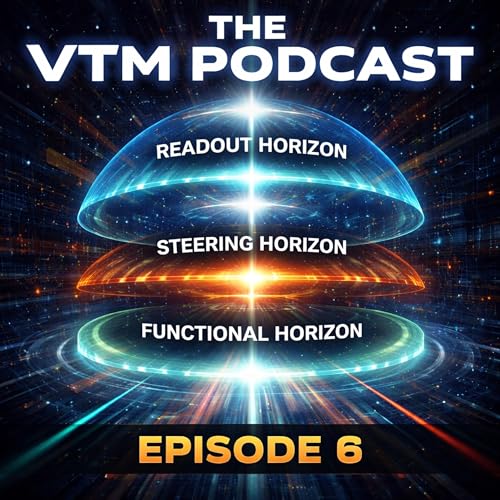
The VTM Podcast by Dr. Ralph Clayton Podcast By Dr. Ralph Clayton cover art

The VTM Podcast by Dr. Ralph Clayton

The VTM Podcast by Dr. Ralph Clayton

By: Dr. Ralph Clayton
Listen for free

🎙 The VTM Podcast


What if the future isn’t approaching you… but already exists?

The VTM Podcast explores the cutting edge of science and the architecture of tomorrow — from theoretical physics and complexity science to artificial intelligence, information theory, and the Volumetric Time Model.

In this series, we examine a bold idea: that time may not be a river flowing forward, but a structure — a vast geometric landscape where past, present, and future coexist. Not destiny. Not superstition. But physics.

If modern science suggests that spacetime is a four-dimensional object, what does that mean for free will? For causality? For the strange sensation that certain events feel inevitable long before they occur?

Each episode pushes into the frontier where cosmology meets computation, where prediction collides with agency, and where humanity confronts the possibility that the universe is far more structured than we imagined.

We’ll explore:

  • The science behind time as a dimension
  • How advanced systems reshape human decision-making
  • Why prediction can survive even when control disappears
  • What emerging technologies reveal about the geometry of reality
  • And how the Volumetric Time Model fits into a future shaped by AI, quantum theory, and complex networks

This is a podcast about big ideas — the kind that challenge how you see the universe and your place within it.

Because if time has a shape…


All rights reserved. 2026. Ralph Clayton
Astronomy Astronomy & Space Science Philosophy Physics Science Social Sciences
Episodes
  • The VTM Podcast - Episode 7 - The Geometry of Lost Leverage
    Mar 23 2026

    Show Summary:

    In this episode, host Ralph Clayton introduces the core ideas behind his book The Volumetric Time Model: Why the Future Feels Decided. Rather than treating time as something that flows, Clayton explores the concept of reality as a fixed, four-dimensional structure—where past, present, and future all coexist, but our access to them is limited.

    At the heart of the discussion is a deeply familiar human experience: the unsettling moment when you can clearly see what’s coming, yet feel powerless to change it. Clayton frames this as “Forecasting Without Power” (F.A.W.P.)—a condition where prediction remains strong, but meaningful influence has already slipped away.

    Through examples ranging from astronomy to relationships, medicine, and modern systems, the episode examines how delayed signals, shrinking windows of action, and weak connections between decisions and outcomes shape our sense of agency. The focus shifts from whether the future is predetermined to a more practical question: when and where do we actually have the power to act?

    This episode sets the stage for a broader framework that challenges common assumptions about control, responsibility, and timing—arguing that true agency depends not just on knowledge, but on access to the right moment to act.

    Show more Show less
    22 mins
  • The VTM Podcast - Episode 6 - The Three Horizons: Why Seeing Isn’t the Same as Control
    Mar 18 2026
    In episode six of the Volumetric Time Model series, Ralph Clayton deepens the framework by introducing one of its most practical and clarifying ideas so far: the separation of reality into three distinct horizons of access.Up to this point, the series has explored a central tension—how something can fully exist while remaining only partially accessible to an embedded observer. We’ve looked at the difference between existence and access, the experience of forecasting without power, the limits defined by the agency horizon, and the growing gap between seeing and steering.This episode takes the next step by asking a sharper question: when something moves beyond your reach, what exactly is it that you’ve lost?Is it your ability to see what’s happening?Your ability to influence it?Or the ability for the system itself to keep functioning?These are not the same thing.Ralph introduces three separate horizons:The readout horizon, which defines the limits of what you can still perceive or extract as meaningful information. A process can still be unfolding in reality, but the signals reaching you may be too weak, delayed, distorted, or incomplete to be useful. The world has not gone silent—but for you, it effectively has.The steering horizon, which marks the point beyond which your actions no longer have meaningful causal impact. You may still see clearly. You may understand exactly what is happening and where it is going. But your ability to intervene arrives too late, too weakly, or into too much accumulated momentum to change the outcome.And the functional horizon, which is not about you at all, but about the system itself. This is the boundary where a process stops holding together—where instability, breakdown, or collapse takes over. A system can remain visible even as it fails, and it can continue running long after your influence over it has disappeared.By separating these three horizons, this episode dismantles a common but costly confusion: the tendency to treat all limits as the same kind of loss. We often assume that if we cannot control something, we must not understand it—or that if we can still see it, we must still be able to change it. But real life is more layered than that.A relationship can remain fully legible even after it has stopped being steerable.A health problem can be visible long before meaningful intervention happens.A project, a market, or even a society can signal its direction clearly while the window for changing course is already closing.This is the core asymmetry: knowledge and leverage are not the same currency.The episode also explores how these horizons can shift in different orders depending on the situation. Sometimes you lose control before you lose visibility. Sometimes poor visibility is exactly what destroys your ability to act. And sometimes systems fail so abruptly that all three horizons collapse at once.Beyond theory, Ralph brings the framework into everyday life—showing how misidentifying which horizon you’re facing leads to the wrong response. What looks like a motivation problem may actually be a feedback problem. What feels like ignorance may actually be a loss of leverage. What gets labeled as lack of discipline may really be an issue of timing, delay, or accumulated momentum.Each horizon demands a different kind of response:When readout fails, you need better signal, clearer feedback, and improved visibility.When steering fails, you need earlier action, tighter loops, and greater leverage.When function fails, the problem shifts toward stabilization, containment, and survival.Understanding which horizon you are actually dealing with can mean the difference between effective action and wasted effort.At a deeper level, this episode reinforces one of the central insights of the Volumetric Time Model: that access to reality is not all-or-nothing. Instead, it is layered, partial, delayed, and asymmetric. You may still have signal without control, or control without clarity, or a functioning system that is already on the path to failure.This is not a pessimistic view—it is a clarifying one.Because once you stop collapsing everything into a single vague idea of “access,” you can begin to see where possibility still exists. If you can still read, you are not in total darkness. If you can still steer, even slightly, the window is not fully closed. And if the system is still functional, there may still be room to recover or adapt.The three horizons—readout, steering, and function—offer a more precise map of reality as it is actually experienced from the inside.And with that map, confusion starts to fall away.This episode is for anyone who has ever felt the strange tension of seeing something clearly but being unable to change it—and for anyone trying to understand where, exactly, their limits really are.Because in the end, clarity, influence, and stability are not the same thing—and knowing the difference changes everything.Support this ...
    Show more Show less
    30 mins
  • VTM Podcast - Episode 5 - The Leverage Gap: Why You Can See Problems Coming But Still Can’t Stop Them
    Mar 15 2026

    In episode five of the Volumetric Time Model series, Ralph Clayton introduces one of the most important ideas in the framework: the Leverage Gap.

    The Leverage Gap is the space between what you can still detect and what you can still change. It is the distance between seeing the direction of events and still having enough practical influence to redirect them.

    Many people have experienced a version of this. You sense a relationship drifting before it officially ends. You feel burnout building before the crash. You notice financial pressure growing before the situation breaks. You recognize a habit taking you somewhere bad even while struggling to interrupt it.

    In moments like these, people often blame themselves: “I knew this would happen, so why didn’t I stop it?”

    But this episode explores a different explanation.

    In many real systems, prediction is easier than control.

    You can often read the trajectory of a situation long after the forces shaping that situation have built up momentum. As options narrow and structures harden, the future can become easier to forecast even while your practical leverage over the outcome begins to shrink.

    This episode explores:

    • Why visibility and influence are not the same thing
    • Why people frequently experience “late clarity” but reduced control
    • The difference between readout (understanding the pattern) and leverage (having a real steering point)
    • Why waiting for perfect certainty can actually make problems harder to change
    • How timing, feedback, momentum, and system structure affect real-world agency

    Through everyday examples—relationships, health, work, money, habits, and large social systems—this episode shows how the separation between prediction and control appears throughout normal life.

    Understanding the Leverage Gap helps explain why people sometimes feel haunted by their own foresight. It also points toward a practical lesson: meaningful change often depends less on perfect understanding and more on acting earlier, while leverage is still alive.

    If you can learn to distinguish between improving your readout and improving your leverage, you can begin to move earlier in the timeline of a problem—when small actions still have the power to redirect outcomes.

    This is episode five of the Volumetric Time Model series.

    In the next episode, we take the next step: can the Leverage Gap actually be measured?


    Support this podcast at — https://redcircle.com/the-vtm-podcast-by-dr-ralph-clayton/exclusive-content
    Show more Show less
    45 mins
No reviews yet