• The VTM Podcast - Episode 7 - The Geometry of Lost Leverage
    Mar 23 2026

    Show Summary:

    In this episode, host Ralph Clayton introduces the core ideas behind his book The Volumetric Time Model: Why the Future Feels Decided. Rather than treating time as something that flows, Clayton explores the concept of reality as a fixed, four-dimensional structure—where past, present, and future all coexist, but our access to them is limited.

    At the heart of the discussion is a deeply familiar human experience: the unsettling moment when you can clearly see what’s coming, yet feel powerless to change it. Clayton frames this as “Forecasting Without Power” (F.A.W.P.)—a condition where prediction remains strong, but meaningful influence has already slipped away.

    Through examples ranging from astronomy to relationships, medicine, and modern systems, the episode examines how delayed signals, shrinking windows of action, and weak connections between decisions and outcomes shape our sense of agency. The focus shifts from whether the future is predetermined to a more practical question: when and where do we actually have the power to act?

    This episode sets the stage for a broader framework that challenges common assumptions about control, responsibility, and timing—arguing that true agency depends not just on knowledge, but on access to the right moment to act.

    Show more Show less
    22 mins
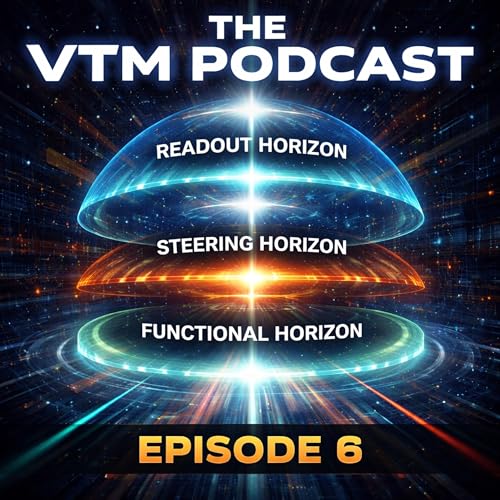
  • The VTM Podcast - Episode 6 - The Three Horizons: Why Seeing Isn’t the Same as Control
    Mar 18 2026
    In episode six of the Volumetric Time Model series, Ralph Clayton deepens the framework by introducing one of its most practical and clarifying ideas so far: the separation of reality into three distinct horizons of access.Up to this point, the series has explored a central tension—how something can fully exist while remaining only partially accessible to an embedded observer. We’ve looked at the difference between existence and access, the experience of forecasting without power, the limits defined by the agency horizon, and the growing gap between seeing and steering.This episode takes the next step by asking a sharper question: when something moves beyond your reach, what exactly is it that you’ve lost?Is it your ability to see what’s happening?Your ability to influence it?Or the ability for the system itself to keep functioning?These are not the same thing.Ralph introduces three separate horizons:The readout horizon, which defines the limits of what you can still perceive or extract as meaningful information. A process can still be unfolding in reality, but the signals reaching you may be too weak, delayed, distorted, or incomplete to be useful. The world has not gone silent—but for you, it effectively has.The steering horizon, which marks the point beyond which your actions no longer have meaningful causal impact. You may still see clearly. You may understand exactly what is happening and where it is going. But your ability to intervene arrives too late, too weakly, or into too much accumulated momentum to change the outcome.And the functional horizon, which is not about you at all, but about the system itself. This is the boundary where a process stops holding together—where instability, breakdown, or collapse takes over. A system can remain visible even as it fails, and it can continue running long after your influence over it has disappeared.By separating these three horizons, this episode dismantles a common but costly confusion: the tendency to treat all limits as the same kind of loss. We often assume that if we cannot control something, we must not understand it—or that if we can still see it, we must still be able to change it. But real life is more layered than that.A relationship can remain fully legible even after it has stopped being steerable.A health problem can be visible long before meaningful intervention happens.A project, a market, or even a society can signal its direction clearly while the window for changing course is already closing.This is the core asymmetry: knowledge and leverage are not the same currency.The episode also explores how these horizons can shift in different orders depending on the situation. Sometimes you lose control before you lose visibility. Sometimes poor visibility is exactly what destroys your ability to act. And sometimes systems fail so abruptly that all three horizons collapse at once.Beyond theory, Ralph brings the framework into everyday life—showing how misidentifying which horizon you’re facing leads to the wrong response. What looks like a motivation problem may actually be a feedback problem. What feels like ignorance may actually be a loss of leverage. What gets labeled as lack of discipline may really be an issue of timing, delay, or accumulated momentum.Each horizon demands a different kind of response:When readout fails, you need better signal, clearer feedback, and improved visibility.When steering fails, you need earlier action, tighter loops, and greater leverage.When function fails, the problem shifts toward stabilization, containment, and survival.Understanding which horizon you are actually dealing with can mean the difference between effective action and wasted effort.At a deeper level, this episode reinforces one of the central insights of the Volumetric Time Model: that access to reality is not all-or-nothing. Instead, it is layered, partial, delayed, and asymmetric. You may still have signal without control, or control without clarity, or a functioning system that is already on the path to failure.This is not a pessimistic view—it is a clarifying one.Because once you stop collapsing everything into a single vague idea of “access,” you can begin to see where possibility still exists. If you can still read, you are not in total darkness. If you can still steer, even slightly, the window is not fully closed. And if the system is still functional, there may still be room to recover or adapt.The three horizons—readout, steering, and function—offer a more precise map of reality as it is actually experienced from the inside.And with that map, confusion starts to fall away.This episode is for anyone who has ever felt the strange tension of seeing something clearly but being unable to change it—and for anyone trying to understand where, exactly, their limits really are.Because in the end, clarity, influence, and stability are not the same thing—and knowing the difference changes everything.Support this ...
    Show more Show less
    30 mins
  • VTM Podcast - Episode 5 - The Leverage Gap: Why You Can See Problems Coming But Still Can’t Stop Them
    Mar 15 2026

    In episode five of the Volumetric Time Model series, Ralph Clayton introduces one of the most important ideas in the framework: the Leverage Gap.

    The Leverage Gap is the space between what you can still detect and what you can still change. It is the distance between seeing the direction of events and still having enough practical influence to redirect them.

    Many people have experienced a version of this. You sense a relationship drifting before it officially ends. You feel burnout building before the crash. You notice financial pressure growing before the situation breaks. You recognize a habit taking you somewhere bad even while struggling to interrupt it.

    In moments like these, people often blame themselves: “I knew this would happen, so why didn’t I stop it?”

    But this episode explores a different explanation.

    In many real systems, prediction is easier than control.

    You can often read the trajectory of a situation long after the forces shaping that situation have built up momentum. As options narrow and structures harden, the future can become easier to forecast even while your practical leverage over the outcome begins to shrink.

    This episode explores:

    • Why visibility and influence are not the same thing
    • Why people frequently experience “late clarity” but reduced control
    • The difference between readout (understanding the pattern) and leverage (having a real steering point)
    • Why waiting for perfect certainty can actually make problems harder to change
    • How timing, feedback, momentum, and system structure affect real-world agency

    Through everyday examples—relationships, health, work, money, habits, and large social systems—this episode shows how the separation between prediction and control appears throughout normal life.

    Understanding the Leverage Gap helps explain why people sometimes feel haunted by their own foresight. It also points toward a practical lesson: meaningful change often depends less on perfect understanding and more on acting earlier, while leverage is still alive.

    If you can learn to distinguish between improving your readout and improving your leverage, you can begin to move earlier in the timeline of a problem—when small actions still have the power to redirect outcomes.

    This is episode five of the Volumetric Time Model series.

    In the next episode, we take the next step: can the Leverage Gap actually be measured?


    Support this podcast at — https://redcircle.com/the-vtm-podcast-by-dr-ralph-clayton/exclusive-content
    Show more Show less
    45 mins
  • Volumetric Time Model — Episode 4 - How to Widen Agency in Everyday Life
    Mar 10 2026
    How to Widen Agency in Everyday Life

    Hosted by Ralph Clayton

    Episode Summary

    Once you understand that agency can shrink — that the connection between your actions and their outcomes can weaken, blur, or arrive too late — the natural question is: can it grow back? This episode is about exactly that. Ralph Clayton walks through eight practical principles for widening agency in ordinary life, drawn from the Volumetric Time Model framework.

    Key Ideas

    1. Act Earlier, Not Just Harder Agency is often less about force and more about timing. A small correction made early can change an entire trajectory. By the time a problem feels urgent, your options have already narrowed. The cheapest steering happens before the emergency.

    2. Tighten Your Feedback Loops You steer better when the gap between action and consequence is short and clear. Simple tools — budgets, sleep routines, relationship check-ins, journaling — work because they close that gap. The key question to ask in any area of life: How do I get faster feedback here?

    3. Reduce Noise Modern life is full of digital, emotional, social, and informational noise. When your environment is chaotic and your attention is fractured, cause and effect become harder to read. Widening agency is often less about adding more and more about removing interference. A life you can read is a life you can steer.

    4. Build Buffers Urgency compresses agency. When there's no margin — no financial cushion, no time slack, no emotional reserve — even small shocks arrive at full speed. Buffers preserve the room needed to think, notice, recover, and act before the situation decides for you.

    5. Move Upstream Most people are stuck in cleanup mode — reacting to consequences rather than addressing causes. Upstream thinking asks: What keeps creating this result in the first place? Changing the structure is less dramatic than fighting the same fire repeatedly, but far more powerful.

    6. Make Your Inner Story More Accurate People don't just react to events — they react to their interpretation of events. Catastrophising ("I always fail") adds noise and pushes toward panic or avoidance. Replacing it with sharper, more accurate language ("I'm acting late inside a pattern that already has momentum") gives you traction for diagnosis rather than drowning.

    7. Build Small, Successful Contact with Reality Small wins aren't just motivating — they're structurally important. They prove the channel still works. Agency grows through repeated successful contact with reality, not through giant declarations or self-punishment.

    8. Choose the Right Target You cannot fully control other people, the economy, or every outcome. That's not the problem. The problem is spending energy on what barely responds while ignoring what is still highly responsive. Real agency means better aim — putting effort where your influence still connects.

    Key Quotes"Earlier action beats stronger action surprisingly often.""A life you can read is a life you can steer.""Urgency compresses agency.""Agency grows through repeated successful contact with reality.""Real agency beats fantasy control every single time."Series Overview

    Episode Topic

    Episode 1Existence vs. Access — why your experience of reality is always partial and delayed

    Episode 2Forecasting Without Power — seeing the outcome without being able to change it

    Episode 3The Agency Horizon — the point where your actions stop meaningfully steering outcomes

    Episode 4Widening Agency — how to push the horizon back in everyday life

    Episode 5 (upcoming)The gap between seeing and steering

    Next Episode

    What exactly is the gap between seeing and steering? Why can you still read the direction of events even after your ability to change them has begun to fade? That's the focus of Episode 5.

    Volumetric Time Model series — Ralph Clayton


    Support this podcast at — https://redcircle.com/the-vtm-podcast-by-dr-ralph-clayton/exclusive-content
    Show more Show less
    34 mins
  • The VTM Podcast Episode 3 - The Agency Horizon: Where Control Begins to Fade
    Mar 8 2026

    In Episode 3 of the Volumetric Time Model series, host Ralph Clayton explores a powerful concept called the Agency Horizon — the point where your actions stop meaningfully influencing the outcomes you care about.

    In the previous episodes, we built the foundation for this idea. Episode 1 introduced the difference between existence and access, showing how reality can be consistent while our experience of it is incomplete, delayed, and filtered through limited signals. Episode 2 introduced Forecasting Without Power — the strange but familiar experience of being able to see where a situation is heading while still feeling unable to change its direction.

    Episode 3 goes deeper by examining why understanding a problem doesn’t always translate into the ability to fix it.

    The Agency Horizon describes the boundary where influence begins to fade. Your actions may still exist, but the connection between what you do and what actually changes in the world becomes weaker, slower, or noisier. Feedback arrives too late, systems gain momentum, signals become blurry, and outcomes stop responding in useful ways.

    This episode challenges the common belief that failure to change something is always a failure of character. Sometimes discipline matters — but often the real issue is structural. The timing may be wrong. The feedback loop may be too delayed. The environment may be too noisy. The situation may already have accumulated too much momentum.

    Through clear examples from relationships, health, finances, and everyday life, the episode shows how people can often predict outcomes long before they lose control over them. In fact, situations frequently become easier to read precisely when they are becoming harder to change. As possibilities narrow and patterns harden, clarity increases — but influence shrinks.

    The episode also introduces the idea of a Control Cliff, a stage that usually appears before the true horizon. This is when systems become fragile, unstable, and expensive to steer even though some influence technically still remains. Many people mistake this stage for normal difficulty and only recognize the problem when control has already collapsed.

    Another key idea explored in the episode is resolution. Agency depends not only on effort but on the clarity of feedback. Stress, noise, distraction, poor communication, and delayed signals all reduce resolution, making it harder to steer life effectively. Improving resolution — through clearer feedback loops, better structure, and reduced noise — can dramatically extend how long meaningful control remains possible.

    Rather than presenting a pessimistic view of human agency, this episode focuses on precision. Understanding where influence fades allows you to stop blaming yourself for the impossible while also identifying where your energy can still make a real difference.

    Key themes in this episode include:

    • Why prediction often outlives control

    • How delayed feedback erodes influence

    • The difference between responsibility and visibility

    • Why fragile systems are a warning sign of shrinking agency

    • How buffers, clearer feedback, and shorter loops protect your ability to steer outcomes

    The goal of the Volumetric Time Model is not to remove responsibility, but to understand the real structure of influence — where actions connect, where they weaken, and where they stop working altogether.

    In Episode 4, the series will move from diagnosis to strategy, exploring how to expand your practical agency, create faster feedback loops, reduce noise, and build structures that allow your actions to matter earlier and more reliably.

    If you’ve ever felt like you could see what was happening but couldn’t change it, this episode provides a framework for understanding why — and what to do next.


    Support this podcast at — https://redcircle.com/the-vtm-podcast-by-dr-ralph-clayton/exclusive-content
    Show more Show less
    44 mins
  • The VTM Podcast - Episode 2 - What is FAWP?
    Mar 5 2026
    Episode 2 – Forecasting Without Power | The VTM Podcast


    In Episode 2 of The VTM Podcast, host Dr. Ralph Clayton continues the exploration of the Volumetric Time Model (VTM) and introduces one of the most recognizable but rarely named experiences of modern life: Forecasting Without Power.

    This episode examines a common psychological and systemic phenomenon — the feeling of seeing outcomes in advance while lacking the ability to change them. Many people experience this in areas like relationships, health, finances, careers, technology, and large social systems. You can recognize the pattern, predict the trajectory, and even explain exactly what will happen next… yet your actions seem unable to alter the result.

    Building on the ideas introduced in Episode 1, Ralph revisits the core VTM distinction between existence and access. The episode explains how our experience of the present moment is shaped not by universal time, but by what we can access through information, signals, memory, and system constraints.

    From there, the discussion moves into the critical difference between prediction and control. In many modern systems, we can observe patterns and forecast outcomes, but our individual actions may lack the timing, leverage, or coupling required to steer those outcomes.

    Through relatable examples involving relationships slowly breaking down, long-term health habits, financial decisions, and delayed feedback loops, the episode illustrates how modern life often separates knowledge from leverage. The result is a powerful psychological state where people feel like spectators inside their own lives — aware of what is happening, but unable to redirect the trajectory.

    This episode also introduces two important concepts within the Volumetric Time Model framework:

    Leverage Gap – the distance between what you can predict and what you can actually influence.

    Agency Horizon – the boundary where your actions stop producing detectable influence within a system.

    Ralph explains how large-scale systems such as markets, institutions, technology platforms, and complex social networks often create conditions where prediction becomes easier while individual control becomes weaker. These systems use delays, filters, noise, and stabilizing structures that protect the system from disruption but can also reduce personal agency.

    Rather than framing this experience as failure or weakness, the episode reframes it as a structural property of complex systems. Understanding the difference between information and leverage can help people stop blaming themselves for outcomes they never had the power to control.

    The episode closes with five practical strategies for responding to Forecasting Without Power:

    • Stop confusing prediction with responsibility

    • Focus on finding levers of influence instead of collecting more information

    • Reduce latency between action and feedback

    • Lower noise and chaos in decision environments

    • Recognize and accept real agency horizons

    These ideas create a bridge to Episode 3, where the concept of the Agency Horizon will be explored in greater detail. The next episode will examine how to detect the boundary where influence collapses and why systems can remain predictable even after meaningful control disappears.

    If you’ve ever said “I knew this was going to happen” and still felt powerless to change it, this episode provides a new way to understand that experience through the lens of systems thinking, control theory, and the Volumetric Time Model.

    The VTM Podcast explores the intersection of time, systems, human perception, agency, prediction, and modern complexity — translating deep theoretical ideas into practical insights about how people experience reality.


    Support this podcast at — https://redcircle.com/the-vtm-podcast-by-dr-ralph-clayton/exclusive-content
    Show more Show less
    36 mins